CChoosing the best caliber for iguanas is one of the most important decisions you can make when setting up your air rifle.
While many people focus on rifle brands or features, caliber is what ultimately determines how effective your setup will be in real-world conditions.
If you’re trying to choose the best air rifle for iguanas, understanding caliber is the foundation of making the right decision. Explore our full guide to the best air rifle for iguanas to see how everything works together.
Different calibers behave very differently in terms of speed, impact, and penetration. Choosing the wrong one can lead to poor results—even if the rifle itself is high quality.
One of the most common mistakes beginners make is assuming that higher velocity automatically means better performance. While speed can help with a flatter trajectory, it does not guarantee effective energy transfer. In many cases, a slightly slower but heavier pellet will deliver far better results. This is why selecting the best caliber for iguanas requires understanding not just speed, but how energy is delivered on impact.
Another important factor is consistency. Larger calibers tend to be more forgiving when it comes to slight variations in shot placement. This gives shooters a better margin of error, especially in real-world situations where conditions are not always ideal. Wind, distance, and shooting angles all play a role, and the right caliber can help compensate for these variables.
Additionally, your environment should influence your decision. If you are typically shooting at shorter distances, you may prioritize accuracy and control. At longer distances, however, you need a caliber that maintains energy and resists environmental factors like wind drift. This balance is what ultimately defines the best caliber for iguanas for your specific use case.
Why Caliber Matters for Iguanas
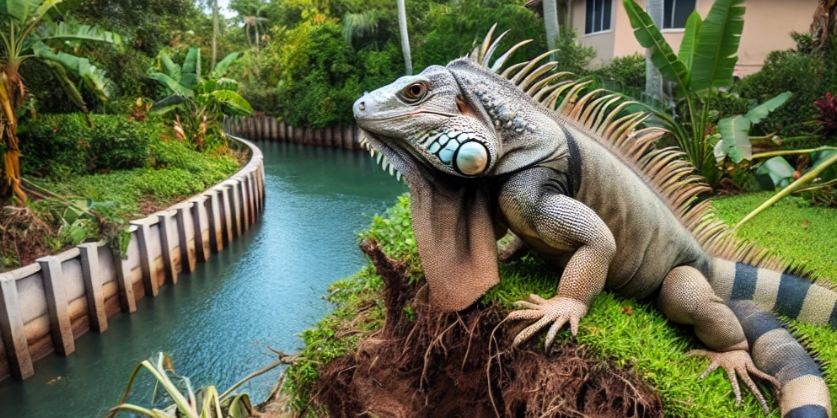
Iguanas are not small or fragile animals. They have:
- Thick, scaled skin
- Dense muscle
- Strong bone structure
Because of this, the best caliber for iguanas must provide enough penetration and energy to be effective.
Caliber directly affects:
- Penetration
- Energy transfer
- Shot effectiveness
A properly selected caliber ensures your setup is both effective and reliable in real-world situations.
Beyond basic penetration, caliber also influences how energy is distributed when the pellet hits the target. A well-chosen caliber delivers energy efficiently, increasing the likelihood of effective results when combined with proper shot placement. This is especially important when dealing with tough animals like iguanas, where precision and impact must work together.
It’s also important to understand that not all calibers perform the same across different rifle types. Some rifles are optimized for specific calibers, meaning your overall setup must be considered as a whole. Matching your rifle, pellet, and caliber correctly is what leads to consistent performance.
Ultimately, choosing the best caliber for iguanas is about finding the right balance between power, accuracy, and usability. When all these elements come together, you get a setup that performs reliably in a variety of conditions, giving you confidence in every shot.
Taking the time to understand these factors will not only improve your results but also help you avoid common mistakes that can limit your performance.
For a deeper understanding of how airgun energy and caliber impact performance in real-world hunting scenarios, you can review this detailed guide from Field & Stream.
.177 vs .22 vs .25 – Key Differences
Understanding the differences between calibers is essential when choosing the best caliber for iguanas.
Each caliber has its own strengths and limitations, and selecting the right one depends on your experience level, shooting distance, and overall setup.
👉 .177 Caliber
Pros:
- Fast velocity
- Flat trajectory
- Lower cost
Cons:
- Limited impact
- Less forgiving
.177 caliber is often favored by beginners because it is affordable and easy to shoot. Its high velocity allows for a flatter trajectory, which can make aiming simpler at shorter distances. However, when it comes to iguanas, the main limitation is its lower mass and reduced energy transfer.
This means that while .177 can work in ideal conditions with perfect shot placement, it is not typically considered the best caliber for iguanas. It requires a higher level of precision and leaves very little margin for error, especially in real-world environments.
👉 .22 Caliber (Best Overall)
Pros:
- Balanced speed and power
- Better energy transfer
- More forgiving
Cons:
- Slightly more pellet drop
.22 caliber is widely considered the best caliber for iguanas because it offers the ideal balance between accuracy and impact. It provides enough mass to deliver effective energy while still maintaining good trajectory and control.
One of the biggest advantages of .22 is its forgiveness. Compared to .177, it gives shooters a slightly larger margin of error, which is especially helpful when dealing with small target areas and unpredictable conditions. This makes it the most versatile option for both beginners and experienced users.
👉 .25 Caliber (Maximum Power)
Pros:
- High impact
- Strong penetration
Cons:
- More drop
- Requires tuning
.25 caliber is designed for maximum impact and penetration. It delivers significantly more energy on target, making it highly effective in the right hands. However, this increased power comes with trade-offs.
The heavier projectile results in more pellet drop and requires better understanding of trajectory and distance. It is also more sensitive to rifle tuning and setup, which makes it better suited for experienced shooters.
For advanced users, .25 can absolutely be part of the best caliber for iguanas, particularly when shooting at longer distances where additional energy retention becomes important.
How Caliber Affects Penetration and Accuracy
Understanding how caliber affects penetration and accuracy is critical when selecting your setup.
Smaller calibers:
- Faster
- Flatter trajectory
- Easier to aim at shorter distances
Larger calibers:
- More impact
- More energy transfer
- Better performance in tougher conditions
The key is finding the right balance. While speed helps with accuracy, impact is what determines effectiveness. The best caliber for iguanas is the one that combines enough velocity for precision with enough mass for reliable penetration.
This balance is why .22 caliber stands out as the most practical and widely recommended option. It performs well across a variety of distances and conditions, making it a dependable choice for most users.
Ultimately, your goal should be to match your caliber with your shooting style, environment, and level of experience.
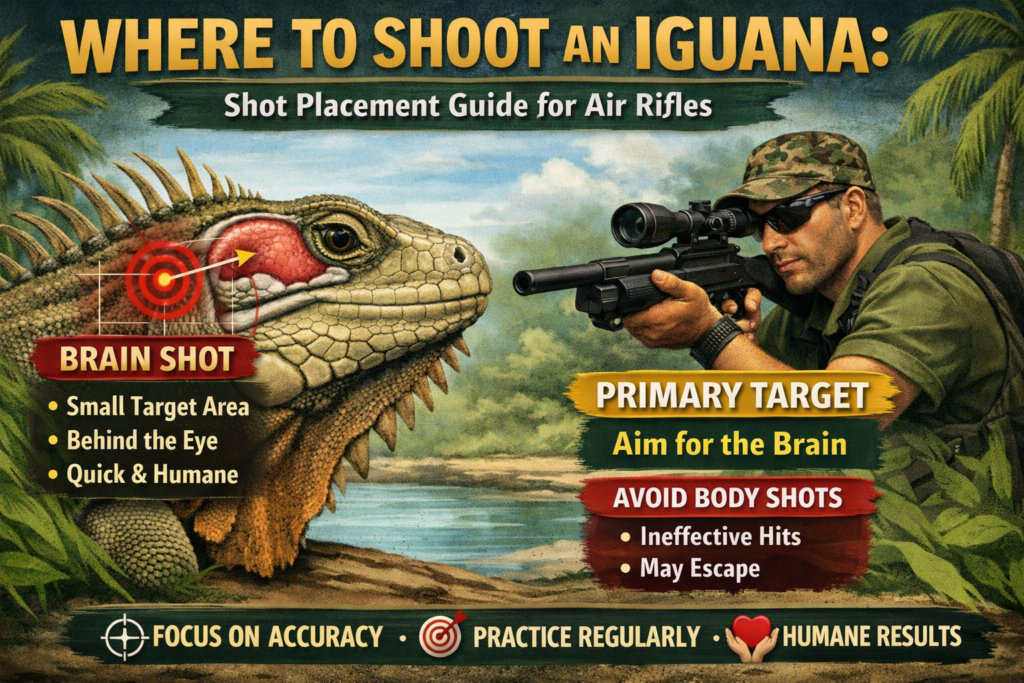
Even with the right caliber, success depends heavily on accuracy. Understanding where to shoot an iguana is essential for consistent results.
Caliber and Distance
Choosing the best caliber for iguanas also depends on your shooting distance.
Close Range (10–25 yards)
- .177 or .22 works
Medium Range (25–50 yards)
- .22 is ideal
Long Range (50+ yards)
- .25 performs best
Distance plays a major role in determining which caliber will perform best in your setup.
Pellet selection also plays a critical role in performance. Understanding different pellet types can help you get the most out of your chosen caliber.
Common Mistakes When Choosing Caliber
Choosing the right caliber can make a huge difference in your overall results, yet many users overlook key factors that affect performance. Avoiding these common mistakes will help you select the best caliber for iguanas and build a more effective setup.
1. Choosing .177 for Everything
It lacks consistent stopping power.
Many beginners default to .177 because it’s widely available and easy to shoot. However, while it performs well for small pest control, it often lacks the impact needed for consistent iguana results. Without perfect shot placement, it may not deliver the effectiveness required.
This is why relying solely on .177 is rarely the best approach when trying to find the best caliber for iguanas.
2. Going Straight to .25
Requires experience and proper setup.
While .25 caliber offers impressive power, it is not always the best starting point. It requires a more advanced understanding of trajectory, tuning, and rifle performance. Many users jump to .25 expecting better results, but without the proper setup, accuracy can suffer.
The best caliber for iguanas should match your experience level, not just your expectations for power.
3. Ignoring Distance
Different calibers perform differently depending on range.
One of the most overlooked factors is shooting distance. A caliber that works well at 20 yards may not perform the same at 50 yards. Smaller calibers may lose energy over distance, while larger calibers require adjustments for pellet drop.
Understanding how distance affects performance is essential when choosing the best caliber for iguanas for your specific environment.
4. Not Matching Caliber with Rifle
Your rifle setup matters.
Not all rifles are optimized for every caliber. Some rifles perform better with certain pellet weights and calibers, which directly impacts accuracy and consistency. Choosing a caliber without considering your rifle can lead to poor performance, even with high-quality equipment.
Matching your rifle, pellet, and caliber correctly is key to achieving reliable results.
Final Thoughts: What Is the Best Caliber for Iguanas?
To summarize:
👉 .177 → Limited use
👉 .22 → Best overall
👉 .25 → Advanced setups
For most users, the best caliber for iguanas is .22.
It offers:
- Reliable accuracy
- Good penetration
- Consistent performance
It also provides a forgiving balance between speed and impact, making it suitable for a wide range of conditions and experience levels.
If you’re building a complete setup, combining the right caliber with the best air rifle for iguanas will give you the most consistent results. Over time, as you gain experience, you can explore other calibers, but starting with the right foundation will significantly improve your performance.
Ultimately, choosing the best caliber for iguanas is about understanding your needs, practicing consistently, and selecting equipment that works together as a complete system.