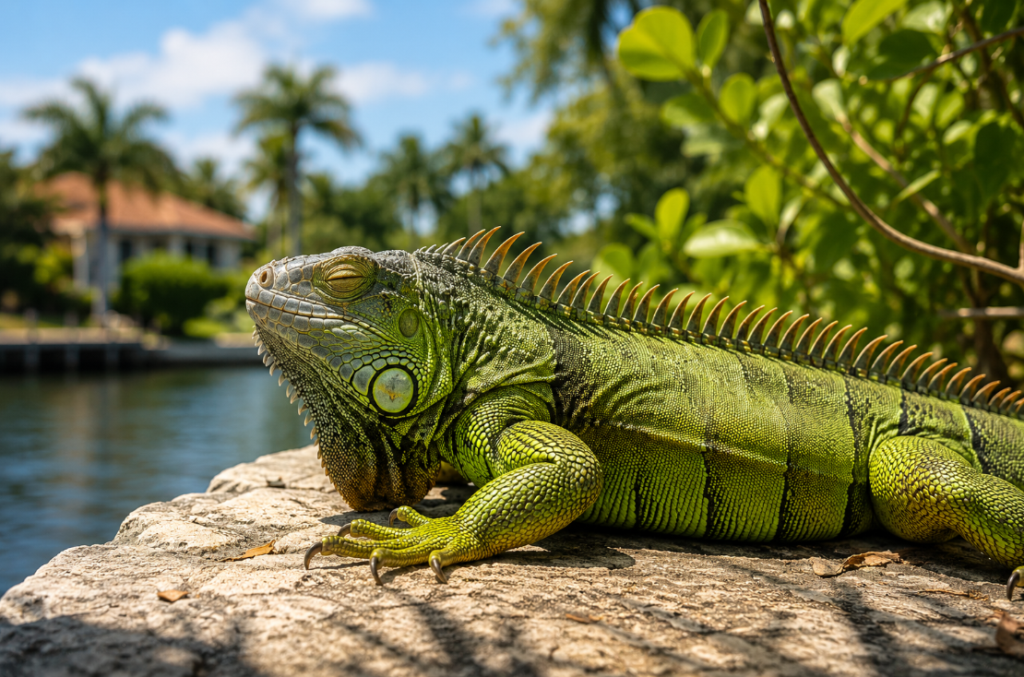
Over the past several decades, Florida has become home to a growing population of invasive green iguanas. Originally introduced through the exotic pet trade, these reptiles have established breeding populations throughout many parts of South Florida and continue to expand their range.
While some people view iguanas as interesting wildlife, property owners often have a very different perspective.
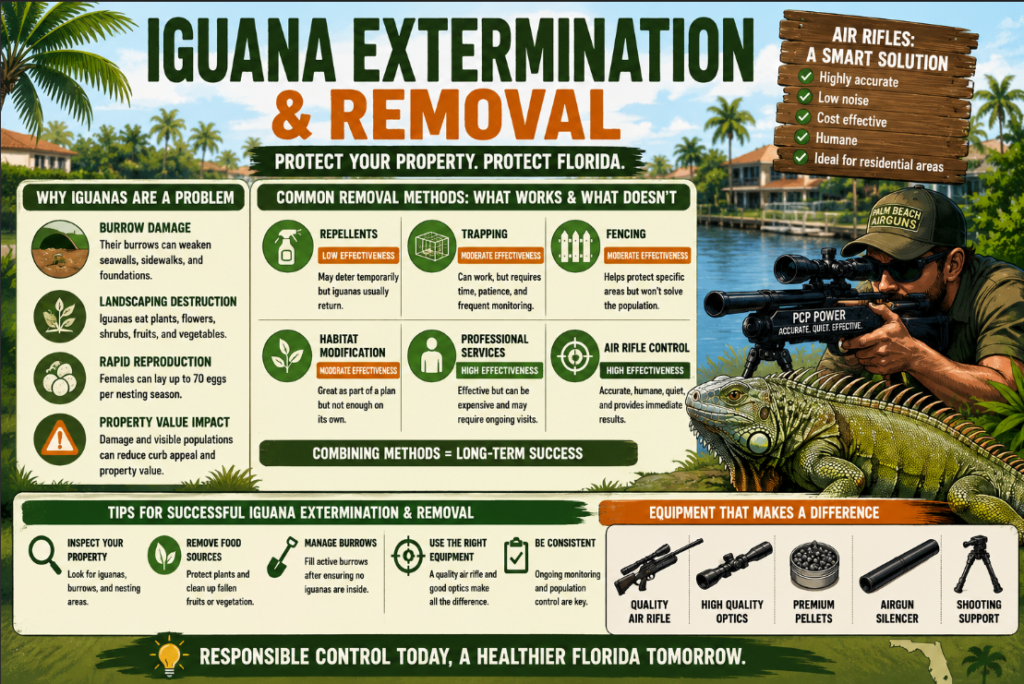
Large populations of iguanas can cause extensive damage to landscaping, gardens, seawalls, sidewalks, docks, and other structures. Their burrowing habits are particularly problematic, as tunnels can weaken soil and contribute to erosion around canals and waterfront properties.
As a result, iguana hunting has become increasingly popular among Florida homeowners, land managers, and outdoor enthusiasts looking for effective ways to help control invasive populations.
Modern air rifles have played a major role in this trend. Today’s PCP airguns offer exceptional accuracy, quiet operation, and the precision necessary for humane harvesting. Combined with proper hunting practices, they provide an effective solution for managing nuisance iguanas while minimizing disturbance to surrounding areas.
Whether you’re dealing with a handful of iguanas in your backyard or larger populations around commercial properties, understanding how these reptiles behave is the first step toward successful control.
In this guide, we’ll cover everything you need to know about iguana hunting in Florida, including where to find iguanas, the best equipment to use, hunting strategies, legal considerations, and common mistakes that can reduce your success.
Why Iguana Hunting Has Become So Popular in Florida
The popularity of iguana hunting is directly tied to the rapid growth of invasive iguana populations throughout Florida.
Green iguanas thrive in warm climates and have adapted extremely well to Florida’s environment. They reproduce efficiently, face relatively few natural predators, and often find abundant food sources in residential neighborhoods.
As populations increase, so do the problems they create.
One of the most significant concerns involves burrowing.
Iguanas dig extensive underground tunnel systems that may:
- Damage seawalls
- Contribute to erosion
- Undermine sidewalks
- Destabilize landscaping
- Create safety hazards
Property owners living near canals, lakes, and waterfront areas are especially vulnerable to this type of damage.
Landscaping losses are another common complaint.
Iguanas feed on a wide variety of plants, flowers, fruits, and vegetables. Many homeowners invest significant time and money maintaining attractive gardens only to discover that local iguanas have turned those landscapes into an all-you-can-eat buffet.
Because populations can expand rapidly, waiting too long to address the issue often makes the problem more difficult to manage.
This has led many property owners to explore practical control options, including iguana hunting.
Another reason iguana hunting has gained popularity is accessibility.
Unlike many traditional hunting activities, opportunities often exist directly on private property. Homeowners dealing with nuisance animals may not need to travel long distances to encounter iguanas.
Instead, they may regularly observe them around:
- Seawalls
- Canals
- Docks
- Trees
- Residential communities
- Golf courses
The increasing availability of modern air rifles has also contributed significantly to the growth of iguana hunting.
Many hunters prefer airguns because they offer:
- Excellent accuracy
- Reduced noise
- Affordable ammunition
- Practical performance
- Fast follow-up shots
These characteristics make air rifles particularly well-suited for the environments where iguanas are commonly found.
For many Florida residents, iguana hunting is not simply a recreational activity. It is often a practical response to ongoing property damage and invasive species management challenges.
As awareness of the issue continues to grow, more property owners are learning about effective and responsible methods for controlling local iguana populations.
Homeowners evaluating different control options should also review our guide to iguana extermination and removal, which compares repellents, trapping, habitat modification, professional services, and population management strategies.
Where to Find Iguanas and Understanding Their Habits
One of the biggest mistakes new hunters make is assuming that success depends entirely on equipment.
While choosing the right rifle is important, experienced hunters know that understanding iguana behavior is often the difference between a productive outing and an empty day.
The more you learn about where iguanas live, when they are active, and how they respond to their environment, the easier it becomes to locate them consistently.
Fortunately, invasive green iguanas tend to follow predictable patterns.
Once you understand those patterns, finding them becomes significantly easier.
Why Iguanas Thrive in Florida
Green iguanas are native to Central and South America, where warm temperatures allow them to remain active year-round.
Florida’s climate provides many of the same conditions.
Abundant sunshine, plentiful vegetation, access to water, and relatively mild winters have helped iguanas establish thriving populations throughout much of South Florida.
Unlike many native reptiles, iguanas have adapted particularly well to human-developed environments.
In fact, some of the largest populations are found in residential neighborhoods rather than remote wilderness areas.
Many communities unintentionally provide everything iguanas need:
- Food sources
- Water access
- Basking locations
- Burrowing opportunities
- Protection from predators
This is one reason iguana hunting often takes place around homes, golf courses, marinas, parks, and canal systems.
The Most Common Places to Find Iguanas
If you’re looking for iguanas, certain locations consistently produce sightings.
Canal Banks
Canals are among the most productive locations for iguana hunting.
The combination of water, vegetation, sunlight, and soft soil creates ideal habitat.
Hunters frequently observe iguanas:
- Sunbathing on canal edges
- Resting in nearby trees
- Moving between feeding areas
- Entering burrow systems
Canals also tend to concentrate multiple animals in a relatively small area.
Seawalls and Waterfront Properties
Many waterfront homeowners become interested in iguana control after discovering damage around seawalls.
Iguanas commonly dig burrows near:
- Seawalls
- Retention ponds
- Lakefront properties
- Riverbanks
- Marinas
These areas often provide excellent hunting opportunities because iguanas return repeatedly to the same locations.
If you notice multiple burrow entrances, chances are good that several iguanas are living nearby.
Residential Communities
Some of Florida’s largest iguana populations exist in suburban neighborhoods.
Landscaped yards provide:
- Flowers
- Fruits
- Vegetables
- Decorative plants
- Shade trees
Essentially, many neighborhoods function as giant feeding grounds.
Hunters frequently encounter iguanas:
- Around swimming pools
- Along fences
- In landscaped beds
- On rooftops
- In backyard trees
The challenge in residential areas is often identifying safe shooting opportunities.
This is where accurate PCP rifles and quiet setups become particularly valuable.
Golf Courses
Golf courses offer nearly everything iguanas need.
They provide:
- Open basking areas
- Water features
- Vegetation
- Minimal predator pressure
Many golf course managers actively monitor invasive species because burrowing can damage irrigation systems and landscaping.
Hunters who obtain proper permission often find golf courses highly productive.
Why Trees Are Important
Many people are surprised to learn how much time iguanas spend in trees.
Although they are frequently seen on the ground, iguanas are excellent climbers.
Large adults often use trees for:
- Safety
- Resting
- Temperature regulation
- Observation
Early in the morning, it is common to find iguanas perched on branches warming themselves in the sun.
Experienced hunters regularly scan treetops when searching new locations.
A surprising number of opportunities are missed simply because people focus only on the ground.
Understanding Daily Activity Patterns
Successful iguana hunting often comes down to timing.
Like many reptiles, iguanas rely heavily on external temperatures to regulate their activity levels.
This creates predictable daily patterns that hunters can use to their advantage.
Early Morning
Morning can be one of the best times to locate iguanas.
After cooler nighttime temperatures, many iguanas emerge to bask in sunlight.
During these periods they may remain relatively stationary while absorbing heat.
Hunters often find iguanas:
- On seawalls
- In open grassy areas
- On docks
- Along canal banks
- In trees receiving direct sunlight
Because movement is often limited during this time, careful hunters can sometimes approach closer than they could later in the day.
Midday
As temperatures rise, iguanas become more active.
This is when they frequently:
- Feed
- Travel
- Interact with other iguanas
- Move between habitats
Midday can provide numerous opportunities, but animals are often more alert and likely to flee.
Hunters must pay closer attention to movement and concealment.
Late Afternoon
Late afternoon frequently produces another burst of activity.
Iguanas often feed before settling into overnight resting locations.
This period can be highly productive, particularly in areas with abundant vegetation.
Many experienced hunters schedule outings around these active feeding windows.
Weather and Iguana Behavior
Weather conditions can dramatically influence iguana activity.
Sunny days typically produce the most predictable results.
However, cooler temperatures often create unique opportunities.
When temperatures drop, iguanas become less active and may spend longer periods basking.
Many Florida residents are familiar with news stories about cold-stunned iguanas during winter cold fronts.
Although hunting opportunities exist year-round, understanding seasonal temperature changes can improve success rates significantly.
Signs That Iguanas Are Nearby
Even when animals are not immediately visible, several clues can reveal their presence.
Look for:
Burrow Entrances
Freshly excavated soil often indicates active burrows.
Many burrow entrances measure several inches in diameter and may be found near water or landscaped areas.
Droppings
Large concentrations of droppings frequently indicate regular iguana activity.
Plant Damage
Partially eaten flowers, leaves, fruits, and vegetables can signal nearby feeding activity.
Tracks
Soft soil near canals and seawalls may reveal tracks and travel routes.
Learning to recognize these signs can help hunters locate productive areas even before spotting their first iguana.
Why Patience Matters
One of the most overlooked hunting skills is patience.
Many newcomers move too quickly through an area and unintentionally scare away opportunities.
Iguanas often remain surprisingly motionless when they believe they are concealed.
A hunter who stops periodically and scans carefully will usually spot more animals than someone constantly moving.
Patience also creates better shooting opportunities.
Instead of rushing a shot, experienced hunters wait for a clear presentation and stable shooting position.
This approach not only improves success rates but also promotes more ethical harvesting.
Choosing the best air rifle for iguanas can significantly improve both accuracy and success rates, especially when hunting around residential properties and canal systems.
Combining Knowledge with the Right Equipment
Understanding where iguanas live and how they behave gives hunters a significant advantage.
Once you know where to find them, the next step is selecting equipment capable of delivering accurate and humane results.
Best Equipment for Iguana Hunting
While understanding iguana behavior is essential, having the right equipment can dramatically increase your success rate. The best hunters combine field knowledge with reliable gear that delivers accuracy, consistency, and confidence when opportunities appear.
Fortunately, modern airgun technology has made iguana hunting more effective than ever before.
If you’re trying to compare specific platforms, calibers, and accessories, our guide to the best air rifle for iguanas breaks down the top options currently available for Florida hunters.
From precision PCP rifles to high-quality optics and pellets, today’s hunters have access to equipment specifically suited for invasive species control.
Our detailed guide to choosing an air rifle for iguanas explains how to select the right PCP platform, caliber, optics, pellets, and accessories for your specific hunting environment.
Let’s examine the most important components of a successful iguana hunting setup.
Why Air Rifles Are the Preferred Choice
For many Florida hunters, air rifles have become the preferred tool for iguana control.
Unlike traditional firearms, modern PCP air rifles offer several advantages that make them particularly well suited for the environments where iguanas are commonly found.
Benefits include:
- Excellent accuracy
- Reduced noise
- Affordable ammunition
- Minimal recoil
- Fast follow-up shots
- Practical use around large properties
Many iguanas are encountered near:
- Canals
- Residential communities
- Marinas
- Golf courses
- Waterfront properties
In these environments, accuracy and discretion often matter more than raw power.
This is one reason so many hunters researching iguana hunting eventually begin looking for the best air rifle for iguanas, as a quality PCP platform provides the ideal balance of performance and practicality.
PCP Rifles: The Gold Standard for Iguana Hunting
Among serious hunters, PCP (Pre-Charged Pneumatic) rifles dominate the conversation.
These rifles use compressed air stored in a reservoir to propel pellets with exceptional consistency.
Advantages include:
- Superior accuracy
- Consistent velocity
- Easy shooting characteristics
- Minimal recoil
- Excellent trigger performance
Unlike spring-piston rifles, PCP rifles allow hunters to stay on target through the shot, making precise placement much easier.
This is especially important because iguanas present relatively small target areas.
For ethical harvesting, precision is everything.
Popular options often include:
- FX Impact
- FX Maverick
- FX Panthera
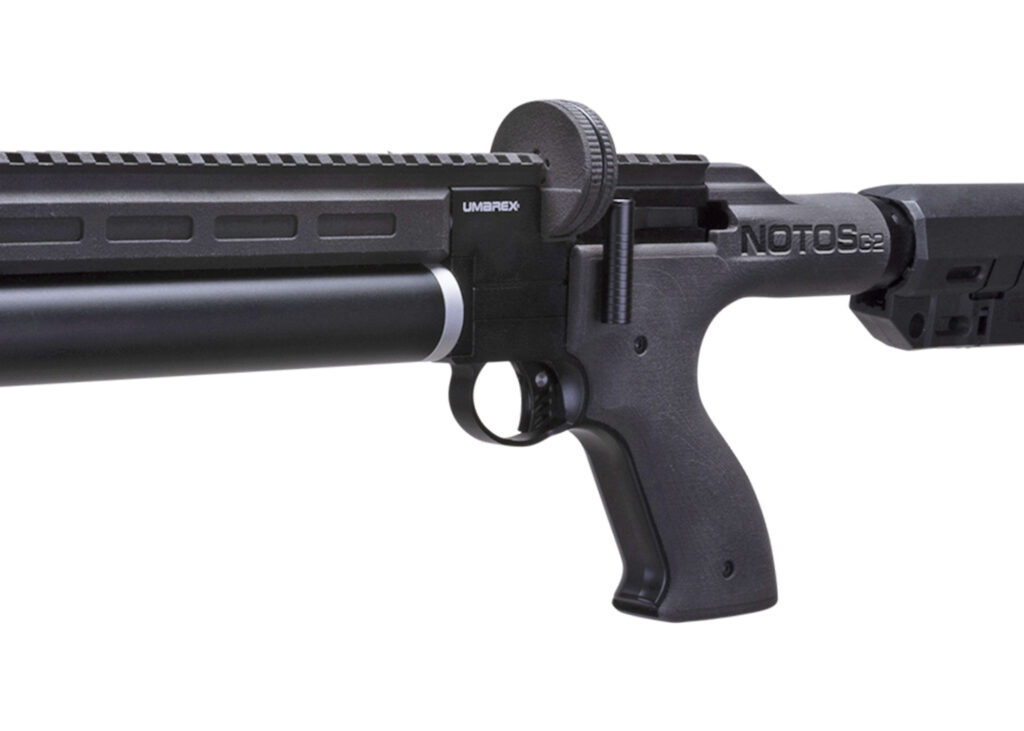
- Umarex Notos
- AirForce Talon
- AirForce Texan
Many of these platforms are regularly recommended when discussing the best air rifle for iguanas because they combine accuracy, reliability, and proven field performance.
Choosing the Right Caliber
The caliber you choose can influence both accuracy and effectiveness.
The most common calibers used for iguana hunting are:
.177 Caliber
Advantages:
- Flat trajectory
- Affordable pellets
- Excellent accuracy
This caliber works well when precise shot placement is prioritized.
.22 Caliber
For many hunters, .22 caliber offers the ideal balance.
Benefits include:
- Increased impact energy
- Excellent penetration
- Wide pellet availability
- Strong overall performance
This is often considered the sweet spot for iguana hunting.
.25 Caliber
Hunters seeking additional energy frequently choose .25 caliber.
Advantages include:
- Greater retained energy
- Improved wind resistance
- Excellent performance on larger iguanas
Many experienced airgunners consider .22 and .25 caliber the most practical options for dedicated iguana control.
The Importance of Quality Optics
A rifle is only as effective as the shooter’s ability to place shots accurately.
That’s where optics become critical.
A quality scope can help hunters:
- Identify targets clearly
- Judge distances more accurately
- Improve shot placement
- Increase confidence in the field
Features worth considering include:
- Adjustable magnification
- Adjustable parallax
- Reliable tracking
- Clear glass quality
- Durable construction
Most hunters find that a scope in the 3-12x or 4-16x range provides more than enough magnification for typical iguana hunting situations.
Extremely high magnification is rarely necessary.
Instead, clarity and reliability should be the primary priorities.
Selecting the Right Pellets
Many hunters underestimate the importance of ammunition.
Even the most expensive rifle can perform poorly if paired with pellets it doesn’t prefer.
Every barrel is slightly different.
Testing several pellet types is one of the most effective ways to improve accuracy.
Common choices include:
- Domed pellets
- Hollow-point pellets
- Hybrid hunting pellets
- Slugs
Many hunters achieve the best overall results with quality domed pellets because they often provide the ideal combination of accuracy and penetration.
In fact, organizations such as the National Shooting Sports Foundation (NSSF) regularly emphasize the importance of matching ammunition to the firearm or airgun being used to maximize accuracy and consistency.
Taking the time to test different pellets can significantly improve field performance.
Why Many Hunters Use Airgun Silencers
Noise is often a major concern during iguana hunting.
Many opportunities occur in suburban environments where excessive noise can become problematic.
This has contributed to the growing popularity of moderated air rifles and airgun silencers.
Benefits include:
- Reduced report
- Less disturbance to neighbors
- Improved shooting comfort
- Easier follow-up opportunities
For hunters operating around residential properties, a quiet setup can be a major advantage.
Many shooters researching equipment eventually discover that pairing the best air rifle for iguanas with a quality airgun silencer creates one of the most effective hunting systems available.
If you’re interested in learning more about noise reduction, be sure to check out our detailed guide on airgun silencers and moderators.
Essential Accessories for Iguana Hunting
Beyond the rifle itself, a few accessories can make hunting easier and more productive.
Shooting Sticks or Bipods
A stable shooting platform improves accuracy and confidence.
Rangefinder
Knowing the exact distance to your target helps ensure proper holdover.
Spare Magazine
Additional magazines can speed up follow-up shots when multiple iguanas are present.
Pellet Pouch
Quick access to ammunition helps keep hunters focused on the environment rather than their gear.
Portable Air Source
For PCP rifles, having access to:
- A compressor
- A hand pump
- A carbon fiber tank
ensures consistent performance throughout the day.
Building a Practical Iguana Hunting Setup
Many successful hunters use surprisingly simple equipment.
A practical setup often consists of:
- Quality PCP rifle
- Reliable scope
- Accurate pellets
- Bipod or shooting sticks
- Airgun silencer
The goal is not to build the most expensive system possible.
The goal is to create a setup that delivers consistent accuracy under real-world conditions.
When equipment is reliable and properly matched to the hunter’s needs, success becomes much more predictable.
In the next section, we’ll cover common mistakes hunters make, important safety considerations, legal topics, and the practical lessons that experienced Florida hunters have learned through years of managing invasive iguana populations.
Common Iguana Hunting Mistakes, Safety Tips, and Final Thoughts
Even with excellent equipment and access to productive hunting locations, many hunters struggle to achieve consistent results because of a few common mistakes.
The good news is that most of these issues are easy to avoid once you understand what causes them.
Whether you’re new to iguana hunting or looking to improve your success rate, paying attention to these lessons can help you become a more effective and responsible hunter.
Common Iguana Hunting Mistakes
Prioritizing Power Over Accuracy
One of the biggest mistakes beginners make is assuming that the most powerful rifle will automatically produce the best results.
In reality, accuracy matters far more.
A perfectly placed shot from an accurate rifle will almost always outperform a more powerful rifle that cannot consistently hit the intended target.
This is why so many experienced hunters spend time researching the best air rifle for iguanas rather than simply buying the highest-powered model available.
Precision should always be the primary goal.
Neglecting Practice
Many hunters purchase a new rifle and head directly into the field.
Unfortunately, unfamiliar equipment often leads to missed opportunities.
Every hunter should spend time learning:
- Pellet trajectory
- Holdovers
- Scope adjustments
- Trigger characteristics
- Wind effects
The more familiar you become with your setup, the more confident you’ll be when an opportunity appears.
Ignoring Pellet Testing
Not all pellets perform the same.
Even premium pellets may produce dramatically different results depending on the rifle.
Testing multiple pellet options is one of the easiest ways to improve accuracy.
Many hunters discover substantial improvements simply by changing ammunition.
Moving Too Quickly
Iguanas have excellent vision.
Hunters who rush through an area often scare away animals before they even notice them.
Successful hunters typically:
- Move slowly
- Stop frequently
- Scan carefully
- Use available cover
Patience consistently produces better results than speed.
Overlooking Trees
Many beginners focus exclusively on the ground.
However, large iguanas spend considerable time in trees.
Always check:
- Branches
- Tree trunks
- Elevated basking locations
Some of the largest iguanas are often found well above ground level.
Safety Tips for Iguana Hunting
Responsible hunting begins with safety.
No matter how experienced you become, safe practices should always remain the highest priority.
Know What Is Beyond the Target
Before taking any shot, verify what lies behind the target.
Never shoot toward:
- Homes
- Roads
- Vehicles
- People
- Pets
A safe backstop is essential.
Use Appropriate Equipment
Equipment should be maintained properly and inspected regularly.
Check:
- Scope mounts
- Air pressure
- Trigger function
- Barrel condition
Reliable equipment contributes directly to safer hunting.
Respect Property Boundaries
Many productive hunting locations are located on private property.
Always obtain permission before entering private land.
Responsible behavior helps maintain positive relationships between hunters and property owners.
Wear Eye Protection
Whenever shooting or handling airguns, proper eye protection is recommended.
Small fragments, debris, or accidental ricochets can create avoidable hazards.
Prioritize Ethical Shot Placement
The goal should always be a quick and humane harvest.
Hunters should only take shots when they are confident they can place them accurately.
If conditions are not ideal, waiting for a better opportunity is often the best decision.
Understanding Florida Regulations
Regulations can change over time, so hunters should always verify current requirements before hunting.
Green iguanas are generally considered an invasive species in Florida, and many property owners actively work to control local populations.
However, responsible hunters should still:
- Verify local ordinances
- Follow property access rules
- Use safe shooting practices
- Stay informed about current regulations
Remaining informed helps ensure that hunting activities remain safe, legal, and effective.
Why Airguns Continue to Grow in Popularity
The rapid advancement of modern airgun technology has transformed invasive species management.
Today’s PCP rifles offer:
- Exceptional accuracy
- Consistent performance
- Reduced noise
- Practical hunting capability
These characteristics have made them one of the most effective tools available for iguana control.
For many hunters, the combination of a quality PCP rifle, a reliable optic, and proper ammunition creates a system capable of delivering excellent results across a wide variety of hunting environments.
As a result, more Florida property owners than ever are discovering the advantages of modern air rifles.
Final Thoughts on Iguana Hunting
Iguana hunting has become an increasingly important activity throughout Florida as invasive populations continue to expand.
Property damage, burrowing, erosion, and landscaping destruction have motivated many homeowners and land managers to seek effective control methods.
Success, however, requires more than simply purchasing equipment.
The most successful hunters understand:
- Iguana behavior
- Habitat preferences
- Daily movement patterns
- Proper shot placement
- Safe hunting practices
When these skills are combined with quality equipment, hunting becomes significantly more productive.
If you’re currently building your setup, be sure to explore our guide on the best air rifle for iguanas, where we compare platforms, calibers, optics, and accessories to help you choose the ideal rifle for your specific needs.
Likewise, if noise reduction is important for your hunting environment, our airgun silencer guide can help you better understand the benefits of moderated airgun systems.
With the right preparation, equipment, and knowledge, iguana hunting can be both an effective invasive species management tool and an enjoyable outdoor activity.