Modern high power PCP air rifles have changed what shooters can expect from an airgun.
Pre-charged pneumatic technology allows manufacturers to combine large air reservoirs, efficient valves, regulators, and heavier projectiles in ways that traditional spring-powered rifles simply cannot match.
That does not mean every shooter needs maximum power.
A more powerful PCP usually consumes more air, may require heavier ammunition, and can reduce the number of shots available from each fill.
The important question is not simply how much power a rifle can produce.
It is how that power fits the way you intend to use the rifle.
This guide explains how high power PCP air rifles generate their performance, how caliber affects power, what happens to shot count as power increases, and what you should consider before choosing a high-performance PCP.
What Is a High Power PCP Air Rifle?
There is no single power level that officially defines a high power PCP air rifle.
Instead, the term generally describes PCP rifles designed to produce more energy than typical recreational or target-oriented airguns.
PCP technology makes this possible because the rifle stores a large amount of compressed air before shooting.
When the trigger is pulled, a controlled amount of that compressed air is released behind the projectile.
A higher-performance system can use:
- Greater air volume
- Higher regulated pressure
- Larger plenums
- More efficient valves
- Heavier projectiles
- Larger calibers
- Longer barrels
These factors work together to produce higher projectile energy.
Why PCP Technology Works So Well for High Power
A traditional spring rifle is limited by the amount of energy that can practically be stored in its spring or gas piston system.
A PCP uses an entirely different approach.
The compressed-air reservoir can store enough energy for multiple shots.
The rifle then meters that energy through a valve.
This gives designers much more flexibility.
A high power PCP air rifle can therefore be configured around larger calibers and heavier ammunition without requiring the shooter to cock an extremely heavy spring before every shot.
That is one of the main reasons modern high-performance air rifles are overwhelmingly built around PCP technology.
High Power Does Not Mean Maximum Velocity
One of the most common mistakes when comparing high power PCP air rifles is looking only at feet per second.
Velocity matters, but it is only one part of performance.
Projectile weight matters too.
A lightweight pellet moving very quickly may produce less energy than a much heavier projectile traveling at a lower velocity.
For that reason, serious comparisons often look at foot-pounds of energy, commonly abbreviated as FPE.
A rifle’s useful performance comes from the combination of projectile weight and velocity, not velocity alone.
Why Caliber Matters
Caliber plays an important role in the performance of high power PCP air rifles.
Larger calibers can use heavier projectiles.
That generally allows the rifle to carry more energy, although it also increases air consumption.
Modern PCP platforms are available across a wide range of calibers.
The right choice depends on the kind of shooting the rifle is intended for.
.177 Caliber
.177 is generally associated with target shooting and lighter projectiles.
It can still be used in powerful PCP platforms, but maximum energy is usually not the main reason someone chooses this caliber.
Advantages include:
- Lower ammunition cost
- Lower projectile weight
- Good air efficiency
- Flatter trajectories at appropriate distances
For pure high-power applications, shooters usually move into larger calibers.
.22 Caliber
.22 is one of the most versatile PCP calibers.
It can be configured for moderate recreational power or significantly higher performance.
A powerful .22 can still provide good shot count while using widely available ammunition.
For shooters who want a balance between efficiency and performance, .22 remains an attractive option.
.25 Caliber
.25 is a popular step up for shooters who want more energy without moving directly into large-bore territory.
Heavier pellets and slugs can provide considerably more performance than smaller-caliber options.
A .25 high power PCP air rifle can still maintain manageable air consumption while providing substantial energy.
.30 Caliber
.30 caliber is where many PCP platforms begin moving firmly into the high-performance category.
The heavier ammunition can carry significantly more energy.
It is also increasingly common to find .30 caliber rifles designed to use both pellets and slugs.
Umarex, for example, currently offers the Gauntlet SL30 as a .30 caliber regulated PCP capable of using both pellets and airgun slugs.
The trade-off is increased air consumption compared with smaller calibers.
.35 Caliber and Larger
Large-caliber PCP rifles can produce much higher energy levels.
This category may include:
- .35
- .357
- .45
- .50
- Other large-bore configurations
These rifles require significantly more air and heavier ammunition.
They may also use larger reservoirs and higher-flow valve systems.
For most recreational shooters, this level of power is unnecessary.
But it demonstrates just how broad the modern PCP category has become.
Pellets vs Slugs in High Power PCP Air Rifles
Ammunition selection becomes increasingly important as power rises.
Traditional diabolo pellets remain extremely popular because they are widely available and work well in many airgun barrels.
Slugs are shaped more like conventional cylindrical projectiles.
Many high power PCP air rifles are designed to take advantage of heavier slugs.
However, not every rifle performs equally well with both.
Barrel design, twist rate, power level, and projectile dimensions can all affect performance.
The best approach is to use ammunition that matches the rifle manufacturer’s recommendations and test different options rather than assuming the heaviest projectile will automatically perform best.
How Regulators Affect High Power
Many modern high power PCP air rifles use regulators.
The regulator controls the pressure delivered from the main reservoir to the firing system.
This can help maintain more consistent shot velocity.
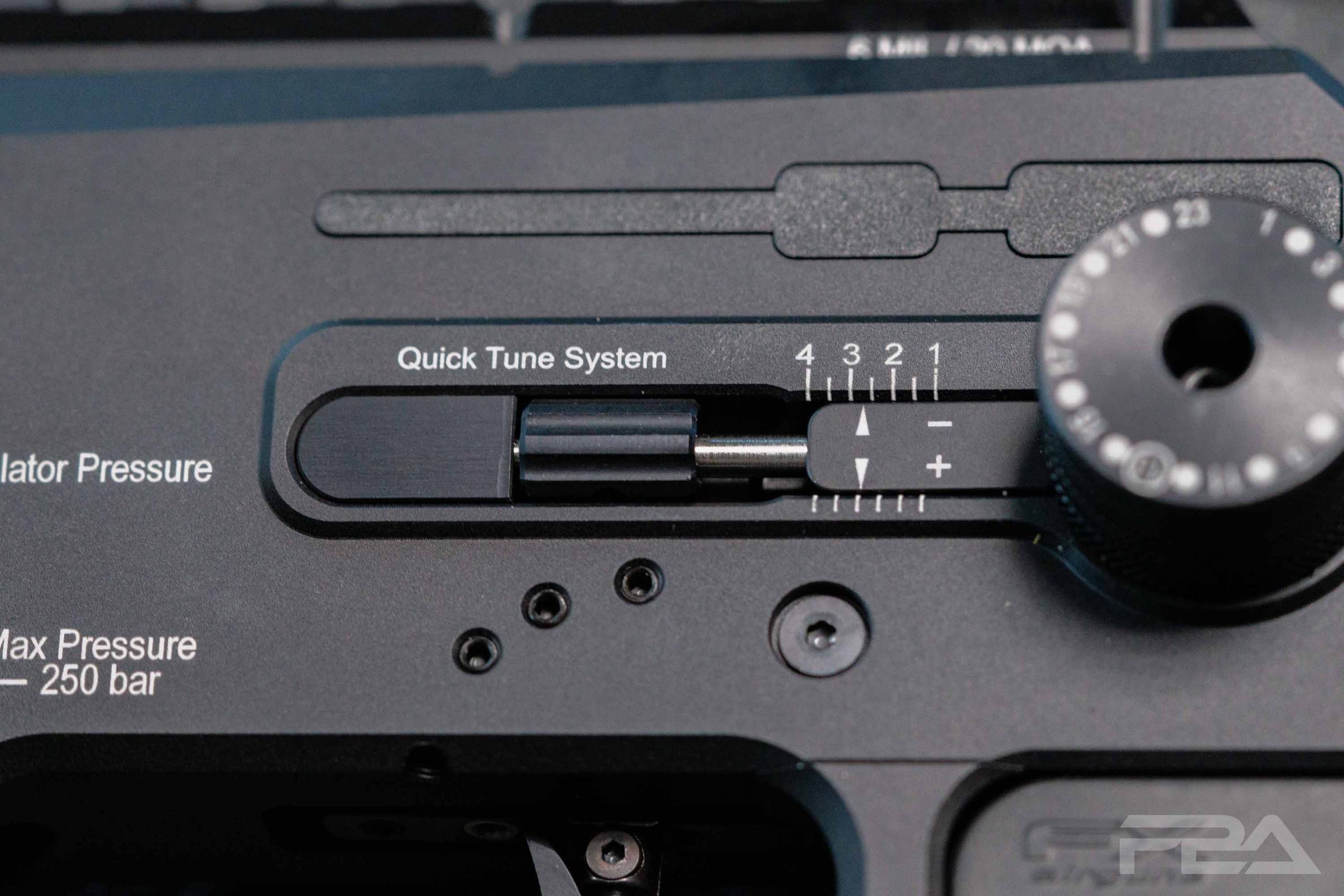
The regulator also becomes part of the rifle’s tuning system.
Changing regulator pressure can affect:
- Projectile velocity
- Air consumption
- Shot count
- Valve behavior
- Overall efficiency
Modern PCP tuning often involves balancing regulator pressure with hammer spring tension and valve behavior rather than simply increasing one setting.
This is why more adjustment does not automatically mean better performance.
The entire system needs to work together.
What Is a Plenum?
A plenum is the chamber that stores regulated air before each shot.
Think of it as a small reservoir prepared specifically for the next firing cycle.
Large plenums can allow more air volume to be released behind the projectile.
That can be important in a high power PCP air rifle using heavy ammunition.
However, more air per shot usually means fewer shots from the reservoir.
This is one of the central trade-offs in high-power PCP design.
Power vs Shot Count
More power usually requires more air.
That means high power PCP air rifles often produce fewer shots per fill than lower-powered rifles with similar reservoir sizes.
For example, one rifle might prioritize efficiency and provide a large number of moderate-power shots.
Another might use substantially more air for each shot to drive heavier ammunition.
Neither design is inherently better.
They are optimized for different purposes.
When comparing rifles, look at power and shot count together.
Reservoir Size Matters
A larger reservoir stores more compressed air.
This can help compensate for the increased air consumption of a high-power platform.
Modern PCP rifles may use:
- Traditional air cylinders
- Removable bottles
- Carbon-fiber bottles
- Dual-bottle configurations
Larger reservoirs can increase shot count, but they can also add size and weight.
For this reason, a high power PCP air rifle should be evaluated as a complete system rather than based only on reservoir capacity.
Fill Pressure Matters Too
Modern PCP systems operate across different maximum fill pressures.
Some use roughly 3,000 PSI.
Others may use 4,350 PSI, 4,500 PSI, or similar high-pressure systems.
A higher fill pressure can allow more air to be stored in a given reservoir size.
However, it also affects filling equipment.
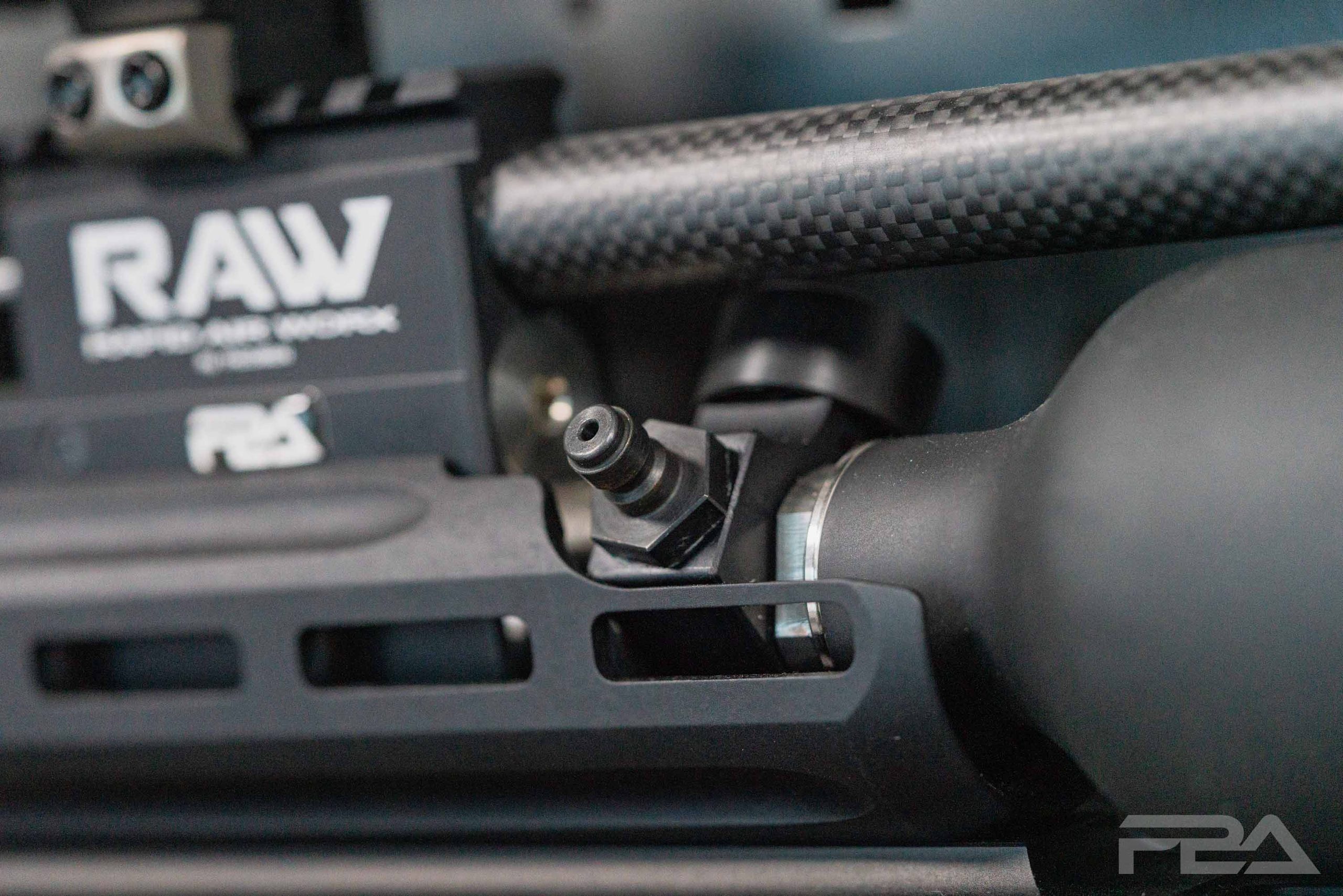
Before buying a high-pressure rifle, make sure your compressor or tank is capable of reaching the required pressure.
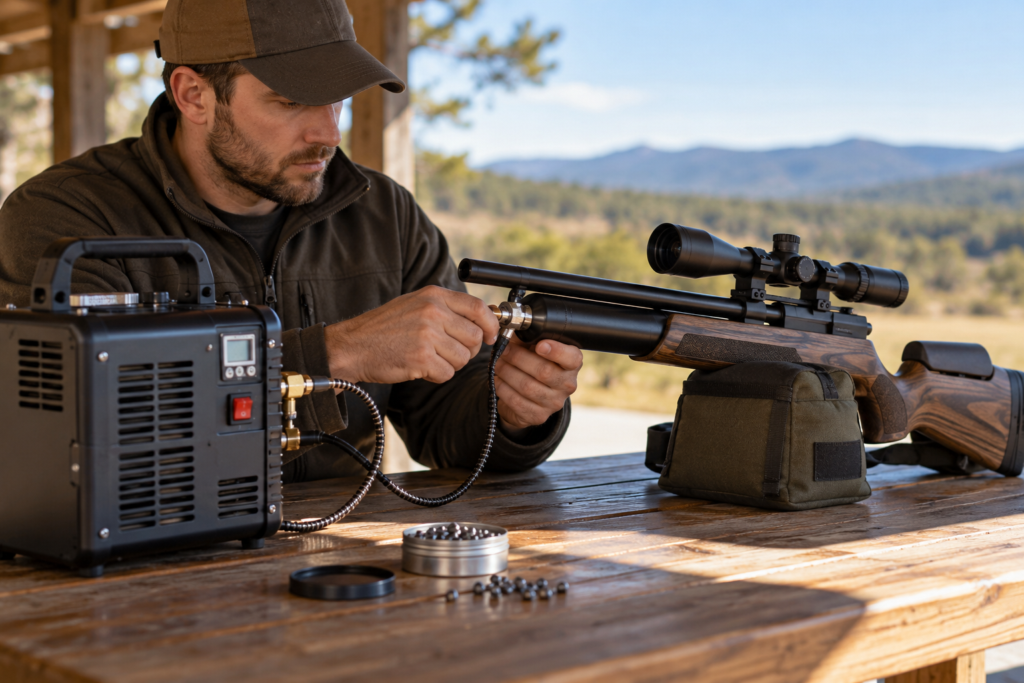
Our How to Fill a PCP Air Rifle guide explains compressors, pumps, HPA tanks, fittings, and pressure requirements in more detail.
High Power PCP Air Rifles and Air Consumption
Air efficiency becomes increasingly important as power rises.
A poorly balanced rifle can waste compressed air without producing useful additional performance.
An efficient high power PCP air rifle uses the appropriate amount of air for the projectile and power level.
Factors affecting efficiency include:
- Regulator pressure
- Valve dwell
- Hammer force
- Plenum volume
- Barrel length
- Projectile weight
This balance is why experienced PCP shooters often focus on efficiency rather than simply maximizing every adjustable setting.
Barrel Length and Performance
Barrel length can influence PCP performance because compressed air continues expanding behind the projectile while it travels through the barrel.
A longer barrel may allow more time for that air to accelerate the projectile.
That can sometimes produce greater efficiency at a given energy level.
However, barrel length is only one variable.
Longer does not automatically mean better.
Manufacturers balance barrel length with valve design, air volume, caliber, and the overall dimensions of the rifle.
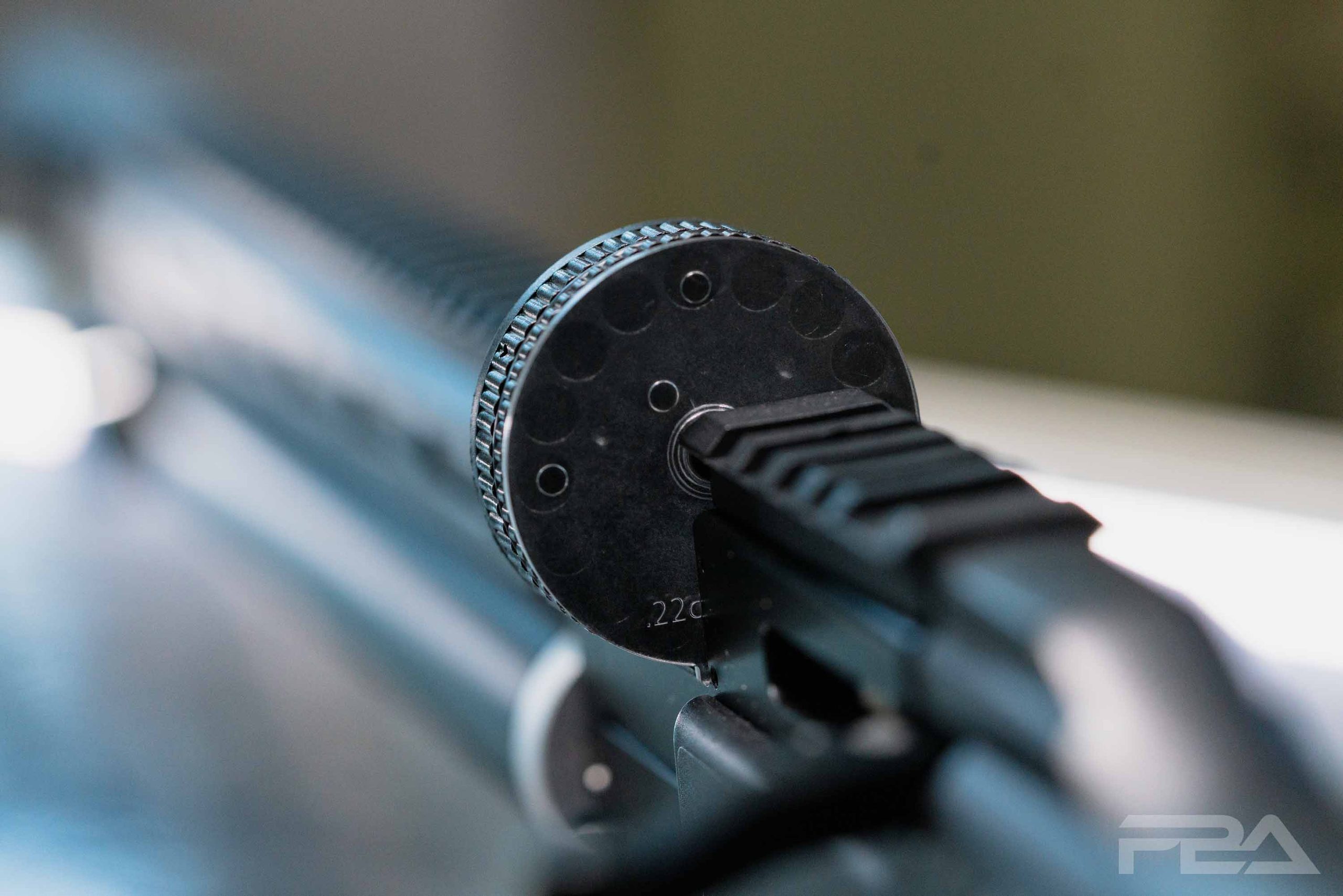
Adjustable Power Systems
Some modern high power PCP air rifles allow the shooter to adjust power externally.
Depending on the platform, this may involve:
- Power wheels
- Hammer spring adjustments
- Adjustable regulators
- Valve controls
These features allow experienced users to configure the rifle around different ammunition or performance goals.
For example, a shooter may choose a lower-power setting when maximum performance is unnecessary.
That can improve shot count and reduce air consumption.
Why Maximum Power Is Not Always the Best Setting
Running a rifle at its maximum possible setting is not always ideal.
More power can bring trade-offs.
These include:
- Lower shot count
- Increased air consumption
- More noise
- Higher ammunition cost
- Greater filling demand
- Potentially more difficult tuning
A well-balanced high power PCP air rifle should deliver enough energy for its intended use while remaining consistent and efficient.
Chasing maximum velocity can sometimes make the overall shooting experience worse.
Accuracy and High Power
Power does not automatically equal accuracy.
A rifle can generate tremendous energy and still perform poorly if the ammunition does not match the barrel or the rifle is badly tuned.
Accuracy depends on:
- Barrel quality
- Projectile selection
- Velocity consistency
- Regulator performance
- Optics
- Shooter technique
- Environmental conditions
Umarex’s current PCP guidance similarly notes that practical accuracy depends on the complete platform rather than caliber alone.
The goal should be consistent, usable performance rather than the highest possible number on a chronograph.
How Much Power Do You Actually Need?
Before choosing among high power PCP air rifles, determine how the rifle will actually be used.
For recreational target shooting, very high power may offer little benefit.
A moderate-power PCP can provide:
- More shots
- Less air consumption
- Lower ammunition costs
- Easier filling
Higher power becomes more relevant when the application requires heavier projectiles or greater retained energy.
The important point is to buy for the intended application.
High Power PCP Air Rifle vs Spring Rifle
High power is one area where PCP technology has a major advantage over spring-powered systems.
Spring rifles are limited by the mechanical energy that can practically be stored and released by the powerplant.
A PCP has access to a reservoir containing high-pressure air.
That allows manufacturers to move substantially heavier ammunition.
PCP rifles can also maintain low recoil despite producing greater projectile energy.
If you’re deciding between these technologies, see our full PCP vs Spring Air Rifle comparison.
Does a High Power PCP Need a Compressor?
Not necessarily, but a compressor can make ownership much easier.
Powerful rifles often have:
- Larger reservoirs
- Higher fill pressures
- Greater air consumption
Those factors can make hand pumping less practical.
An HPA tank can work well, but it eventually needs to be refilled.
For frequent use, a dedicated PCP compressor is often the most convenient solution.
Are High Power PCP Air Rifles Good for Beginners?
Some can be, but beginners do not necessarily need a high-power platform.
A simpler PCP can make it easier to learn:
- Filling
- Pressure management
- Magazine operation
- Pellet selection
- Basic PCP maintenance
Once those fundamentals become familiar, moving into a more powerful or adjustable platform is much easier.
If this is your first PCP, read our Best PCP Air Rifle for Beginners guide before choosing based on maximum power.
What Should You Compare Before Buying?
When shopping for high power PCP air rifles, don’t compare only velocity.
Look at the complete specification.
Important factors include:
- Caliber
- Projectile compatibility
- Energy
- Reservoir capacity
- Maximum fill pressure
- Regulator
- Shot count
- Weight
- Barrel length
- Magazine capacity
- Available adjustments
- Filling requirements
These specifications tell you much more about how the rifle will actually behave.
OUTBOUND DOFOLLOW LINK
For additional information about how caliber relates to PCP performance, Umarex has a useful current guide comparing .177 vs .22 vs .25 PCP air rifles, including how different calibers fit different shooting priorities.
Finding the Right Balance of Power and Performance
The best high power PCP air rifles are not simply the rifles producing the biggest number.
The best setup balances power with:
- Accuracy
- Efficiency
- Shot count
- Air consumption
- Ammunition
- Rifle size
- Filling requirements
Modern PCP technology makes it possible to build everything from compact .22 rifles to large-caliber platforms producing dramatically greater energy.
That flexibility is what makes PCP airguns so interesting.
Instead of asking only, “Which rifle is most powerful?” ask:
How much power do I actually need, and what am I giving up to get it?
That question will usually lead to a much better choice.
If you’re just beginning your research, our complete PCP Air Rifle Guide explains the entire category, including calibers, regulators, filling systems, and buying considerations.
You can also browse Palm Beach Airguns’ air rifles to compare PCP platforms across different calibers, reservoir sizes, power levels, and configurations.
Choosing High Power PCP Air Rifles for Real-World Use
When comparing high power PCP air rifles, specifications are useful, but they do not tell the entire story. The best rifle is one that delivers the level of performance you need without creating unnecessary compromises in weight, air consumption, filling requirements, or ammunition cost.
One major consideration with high power PCP air rifles is how frequently you plan to shoot. A rifle that uses a large amount of compressed air with every shot may provide impressive power, but it will also require more frequent refilling. Shooters who spend long sessions at the range may prefer a setup that balances energy with a reasonable shot count.
Reservoir capacity is another important factor when evaluating high power PCP air rifles. Larger bottles can provide more available air, but they may also make the rifle heavier and change its balance. A compact rifle with slightly less power may sometimes be more practical than a larger platform designed around maximum output.
Ammunition availability should also influence your choice. Some high power PCP air rifles perform especially well with heavy pellets, while others are designed to take advantage of airgun slugs. Before choosing a rifle, make sure the appropriate ammunition is readily available in the caliber you plan to use.
Filling equipment is equally important. Many high power PCP air rifles use large reservoirs or higher operating pressures, making a dedicated compressor particularly useful. Buyers should consider the rifle and its air source as one complete system rather than separate purchases.
Weight and handling should not be overlooked either. Some high power PCP air rifles are primarily designed for supported shooting, while others remain compact enough for easier handling. The ideal configuration depends on where and how you expect to use the rifle.
Another consideration is adjustability. Premium high power PCP air rifles may allow changes to regulator pressure, hammer settings, and other performance variables. These features can be valuable for experienced shooters, but they are not necessary for everyone. A rifle that performs consistently at its factory settings may be the better option for someone who does not want to spend time tuning.
The same applies to caliber. Choosing among high power PCP air rifles should not automatically mean selecting the largest caliber available. A well-balanced .25 or .30 caliber platform may provide all the performance a shooter needs while using less air and offering more shots per fill than a larger-bore alternative.
Ultimately, comparing high power PCP air rifles should come down to practical performance. Look beyond maximum velocity and consider accuracy, energy, shot count, air efficiency, ammunition, rifle weight, and filling requirements together.
The most useful high power PCP air rifles are those that deliver the required performance consistently without adding more size, expense, or complexity than the shooter actually needs.