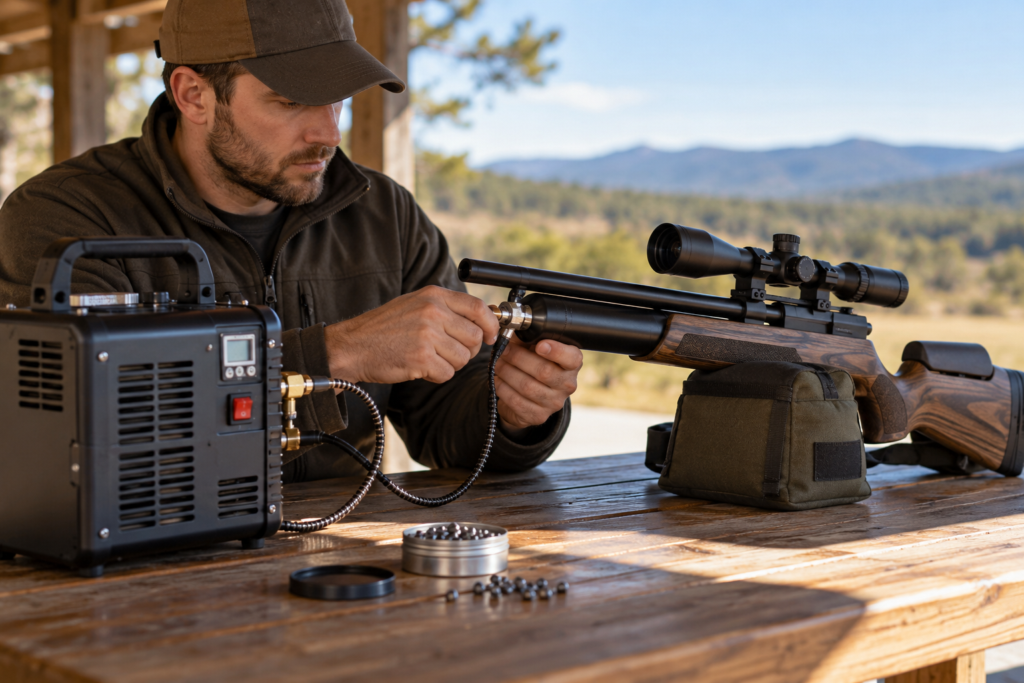
Buying your first PCP air rifle for beginners can feel more complicated than buying a traditional break-barrel air rifle.
There are more terms to understand, more equipment to consider, and more choices when it comes to pressure, caliber, reservoir size, regulators, magazines, and filling systems.
The good news is that modern PCP rifles have become much easier to own.
You no longer need an expensive competition setup just to get started. There are now many beginner-friendly PCP rifles that are accurate, easy to fill, simple to operate, and affordable enough for someone entering the category for the first time.
If you’re looking for the best PCP air rifle for beginners, this guide explains what actually matters before you buy.
Why Choose a PCP Air Rifle as a Beginner?
A PCP rifle may seem more advanced than a spring-powered rifle, but in many ways it can actually be easier to shoot.
If you’re still learning the basics of the platform, start with our PCP Air Rifle Guide for a complete overview of calibers, power systems, and ownership considerations.
A good PCP air rifle for beginners typically offers:
- Very little recoil
- Easy follow-up shots
- Multi-shot magazines
- Smooth cocking
- Consistent accuracy
- Adjustable power on some models
- Comfortable shooting characteristics
A powerful spring rifle can require significant cocking effort and may be sensitive to how it is held.
A PCP rifle usually has a much smoother firing cycle.
That makes it easier for a new shooter to focus on sight picture, trigger control, and consistency rather than managing recoil and hold sensitivity.
What Makes a Good PCP Air Rifle for Beginners?
Not every PCP rifle is ideal for a first-time owner.
Some platforms are highly adjustable and designed for experienced shooters who want to tune regulator pressure, hammer spring tension, valve behavior, and projectile performance.
That level of control can be useful later, but beginners usually benefit from simplicity.
The best PCP air rifle for beginners should be easy to understand, easy to fill, and reliable in its factory configuration.
Here are the most important features to look for.
1. Simple Operation
Your first PCP should not require constant tuning.
Ideally, you should be able to:
- Fill the rifle.
- Load the magazine.
- Cock the action.
- Shoot.
- Refill when necessary.
That sounds obvious, but some advanced PCP rifles provide so many adjustment options that new owners can quickly become overwhelmed.
For a beginner, simple and predictable is often better.
You can always move into more advanced tuning later.
2. Moderate Fill Pressure
Fill pressure matters because it determines what equipment you need to charge the rifle.
Many PCP rifles operate around 3,000 PSI, while some modern systems use considerably higher pressures.
For a beginner, a rifle that works with a common fill pressure can make ownership easier.
It can also make hand pumping more realistic if you are not ready to purchase a compressor.
Before buying any PCP air rifle for beginners, check:
- Maximum fill pressure
- Recommended operating pressure
- Fill fitting type
- Reservoir size
A very large reservoir can provide more shots, but it may also take longer to fill.
3. Good Shot Count
Shot count tells you approximately how many useful shots the rifle can produce before needing another fill.
For beginners, a reasonable shot count makes the experience more convenient.
You do not want to spend more time filling than shooting.
However, shot count should always be considered together with power.
A lower-powered .177 or .22 rifle may produce many shots from one fill.
A more powerful .25 or .30 may use significantly more air.
The ideal PCP air rifle for beginners should provide enough shots for the type of shooting you plan to do without requiring constant refills.
4. A Regulated System
A regulator can be a very useful feature for a new shooter.
A regulated PCP attempts to deliver consistent air pressure to the firing system for each shot.
This can help maintain more consistent velocity as reservoir pressure gradually decreases.
That means the shooter spends less time worrying about pressure changes affecting performance.
Not every beginner rifle needs to be regulated, but it is a valuable feature when available.
If you’re unfamiliar with how regulators work, our How Does a PCP Air Rifle Work? guide explains the entire firing system in simple terms.
5. Easy-to-Find Magazines
Magazine availability may not seem important when you’re buying the rifle, but it quickly becomes important once you start shooting.
A beginner-friendly rifle should have magazines that are:
- Easy to load
- Easy to insert
- Easy to find
- Reasonably priced
Having multiple magazines can make range sessions much more convenient.
Some PCP rifles also allow single-shot loading, which can be useful for target shooting.
6. Common Caliber
For most first-time buyers, it makes sense to start with a common caliber.
The most popular choices are .177, .22, and .25.
Each has advantages.
.177 PCP Air Rifle for Beginners
.177 is a practical option for target shooting and general recreational use.
Advantages include:
- Widely available pellets
- Lower ammunition cost
- Flatter trajectory at moderate distances
- Lower air consumption in many rifles
If precision target shooting is your main goal, .177 can be an excellent starting point.
.22 PCP Air Rifle for Beginners
For many shooters, .22 is the most versatile beginner caliber.
It provides a strong balance between:
- Projectile weight
- Power
- Shot count
- Ammunition availability
- Air efficiency
If you’re unsure where to start, a .22 PCP air rifle for beginners is often one of the easiest choices.
.25 PCP Air Rifle for Beginners
.25 offers more projectile weight and energy.
It can be a good choice for shooters who want additional power but don’t necessarily need a large-caliber platform.
The trade-off is usually greater air consumption and higher ammunition cost.
For a first PCP, .25 can still make sense if your intended use justifies the additional power.
7. A Manageable Rifle Size
The most powerful rifle is not always the easiest rifle to own.
Weight and size matter.
A large bottle rifle with a long barrel may provide excellent performance, but it can feel cumbersome if you’re mainly shooting from a bench or carrying the rifle around your property.
Compact PCP rifles can be especially attractive to beginners.
They are easier to handle, easier to store, and often lighter.
When choosing a PCP air rifle for beginners, pay attention to:
- Overall length
- Weight
- Stock design
- Balance
- Bottle or cylinder size
A rifle that feels comfortable will usually be more enjoyable to shoot.
8. Easy Filling
The rifle is only one part of the PCP setup.
You also need a way to fill it.
This is one of the most important things beginners sometimes overlook.
Common options include:
- PCP hand pump
- High-pressure compressor
- HPA tank
A hand pump is often the least expensive solution.
A compressor is usually the most convenient.
A tank can work well for shooters who want to bring multiple refills to the range.
The best PCP air rifle for beginners should match the filling system you actually plan to use.
For example, hand pumping a small air cylinder may be practical.
Hand pumping a very large bottle to extremely high pressure may be much less enjoyable.
Our upcoming guide to How to Fill a PCP Air Rifle will cover these options in much greater detail.
9. Reliable Manufacturer Support
Your first PCP is not the place to experiment with a rifle that has little documentation or difficult-to-find parts.
Choose a platform from an established airgun manufacturer.
Good support can make it easier to find:
- Replacement magazines
- O-rings
- Fill probes
- Seals
- Manuals
- Spare parts
- Technical information
Palm Beach Airguns carries PCP rifles from established manufacturers including FX Airguns, Umarex, Air Venturi, RAW, Daystate, Brocock, and Western Airguns.
That gives new buyers options across a wide range of prices and configurations.
How Much Should a Beginner Spend?
There is no single correct budget for a first PCP.
However, it’s important to think beyond the rifle price.
Your complete setup may include:
- Rifle
- Scope
- Scope mounts
- Pellets or slugs
- Filling equipment
- Spare magazines
- Case
- Accessories
A lower-priced rifle can be an excellent value, but the total cost of getting started may be higher once filling equipment is included.
This is why new buyers should establish a complete setup budget, not just a rifle budget.
Do You Need an Expensive PCP Compressor?
No.
A compressor is convenient, but it is not mandatory.
Many beginner PCP rifles can be filled with a quality high-pressure hand pump.
That can keep the initial investment lower.
However, shooters who plan to use their PCP frequently may quickly appreciate the convenience of a compressor.
Once you own a compressor, it can normally be used with multiple PCP rifles.
That makes it a long-term part of the setup rather than an accessory for only one rifle.
Should Beginners Buy a Highly Adjustable PCP?
Usually not as their first priority.
If you’re interested in moving beyond beginner setups and into larger calibers or more advanced tuning, read High Power PCP Air Rifles.
Adjustability is useful, but it can create unnecessary complexity.
A highly tunable rifle may allow changes to:
- Regulator pressure
- Hammer spring tension
- Valve settings
- Power output
- Projectile configuration
These features are excellent for experienced shooters who understand what each adjustment does.
Beginners should first learn how a PCP behaves in a stable configuration.
Once you understand shot count, velocity, fill pressure, and ammunition performance, advanced tuning becomes much more useful.
What About the FX Impact?
Platforms such as the FX Impact are popular because they offer extensive performance and adjustment options.
For someone who wants to grow into advanced PCP tuning, that type of platform can be extremely appealing.
However, a beginner does not need that level of adjustment to enjoy PCP shooting.
There are simpler rifles that provide excellent accuracy without requiring as much setup knowledge.
If you’re interested in the FX platform specifically, see our FX Airguns Guide and FX Impact M4 review.
A Compact PCP Can Be a Great First Rifle
Compact rifles can make excellent beginner platforms.
A smaller rifle is easier to maneuver and can be less intimidating than a large bottle gun.
The Umarex Notos is one example of the compact PCP category.
Rifles like this demonstrate that a PCP does not need to be large or extremely complicated to offer a good shooting experience.
For many new owners, ease of use can be more important than maximum power.
PCP Air Rifle for Beginners vs Spring Air Rifle
Some buyers may still be deciding between PCP and spring power.
A spring rifle has one major advantage:
It is completely self-contained.
You do not need a compressor, tank, or hand pump.
A PCP, however, is generally easier to shoot accurately and provides faster follow-up shots.
If you’re deciding between the two systems, our PCP vs Spring Air Rifle guide compares accuracy, recoil, cost, power, and ownership requirements.
Beginner Mistakes to Avoid
Buying your first PCP becomes much easier if you avoid a few common mistakes.
Buying Only for Maximum Power
New shooters often assume more power is always better.
It isn’t.
More power usually means more air consumption, more noise, and often fewer shots per fill.
Choose enough power for your intended use.
Ignoring Filling Equipment
Don’t buy the rifle and then realize you have no practical way to fill it.
Plan the air source at the same time.
Choosing Too Much Complexity
Advanced adjustments can be attractive on paper.
But you do not need them to start.
Reliability and simplicity are more useful when you’re learning.
Buying the Wrong Caliber
Choose caliber based on intended use, not simply size.
A .22 may be more useful to a beginner than a large-caliber rifle that consumes significantly more air and ammunition.
Ignoring Weight
Check the rifle’s total weight, especially once optics are added.
A lightweight rifle may be much more comfortable for extended shooting.
What Should You Buy Alongside Your First PCP?
A basic beginner setup should normally include:
- PCP air rifle
- Suitable filling system
- Quality pellets
- Scope or optic if required
- Correct scope mounts
- Spare magazine
- Basic maintenance supplies
You may also want:
- Rifle case
- Shooting rest
- Chronograph
- Additional fill fittings
- Portable air tank
You do not need everything immediately.
Start with the essentials and add equipment as you gain experience.
Is a PCP Air Rifle Worth It for a Beginner?
For many shooters, yes.
The additional filling requirement is the main difference compared with simpler airgun systems.
Once that is solved, PCP rifles are generally extremely easy and enjoyable to shoot.
Low recoil, smooth operation, multi-shot magazines, and excellent accuracy potential make them very approachable.
A good PCP air rifle for beginners also provides room to grow.
You can start with simple recreational shooting and later explore longer distances, different ammunition, optics, tuning, and more advanced rifles.
Choosing Your First PCP Air Rifle
The best PCP air rifle for beginners is not necessarily the most expensive or powerful rifle.
It should be the rifle that makes learning easy.
Look for:
- Simple controls
- Reliable operation
- Common caliber
- Reasonable fill pressure
- Good shot count
- Easy magazine availability
- Comfortable size and weight
- Strong manufacturer support
Most importantly, plan your complete setup before purchasing.
Understanding how you will fill the rifle, what ammunition you will use, and what type of shooting you plan to do will make the buying process much easier.
If you’re still learning the basics, start with our complete PCP Air Rifle Guide for an overview of PCP power systems, calibers, filling options, and buying considerations.
You can also browse Palm Beach Airguns’ air rifles to compare PCP platforms across different manufacturers, calibers, sizes, and price ranges.
Why a PCP Air Rifle for Beginners Can Be a Smart Long-Term Choice
A good PCP air rifle for beginners is not just an entry-level purchase. It can also be a platform that a new shooter continues using for years.
One of the main advantages of choosing a PCP air rifle for beginners is that the basic shooting experience is easy to learn. Once the rifle is filled, there is very little recoil, the action is usually smooth, and follow-up shots are simple. That allows a new shooter to focus more on accuracy, trigger control, and learning how different pellets perform.
A PCP air rifle for beginners can also make it easier to grow into the hobby without immediately replacing the rifle. As experience increases, the shooter can add better optics, test different pellet weights, upgrade filling equipment, or experiment with different shooting distances.
Another reason to consider a PCP air rifle for beginners is the wide variety of models now available. Buyers can choose between compact rifles, traditional sporting designs, bottle-fed rifles, and lightweight platforms depending on their preferences.
The right PCP air rifle for beginners should still be simple enough to use without constant adjustments. New shooters do not need the most complicated regulator system or the highest possible power output. A dependable rifle that works well straight from the factory is often the better choice.
It is also worth thinking about the total ownership experience. A PCP air rifle for beginners should be paired with a filling method that is realistic for the owner. Someone who shoots occasionally may be comfortable using a hand pump, while a shooter who plans to practice frequently may prefer a compressor.
A well-chosen PCP air rifle for beginners can provide a smooth introduction to pre-charged pneumatic airguns while still offering enough accuracy, power, and flexibility to remain useful as the shooter becomes more experienced.
That is why choosing a PCP air rifle for beginners should be based on simplicity, reliability, caliber, fill pressure, and intended use rather than chasing the most advanced specifications.