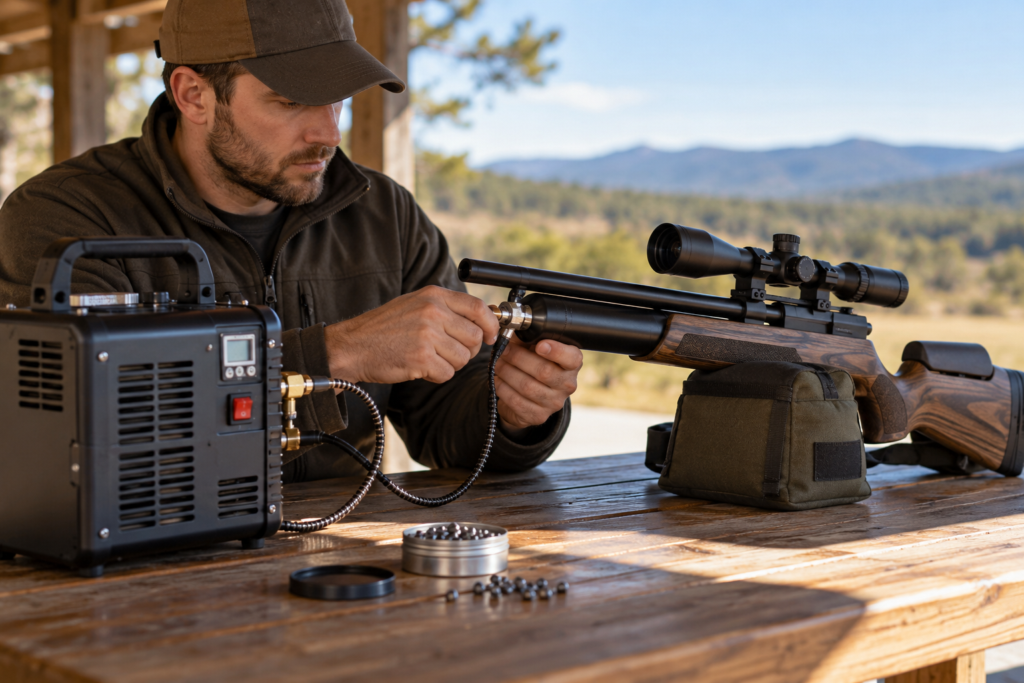
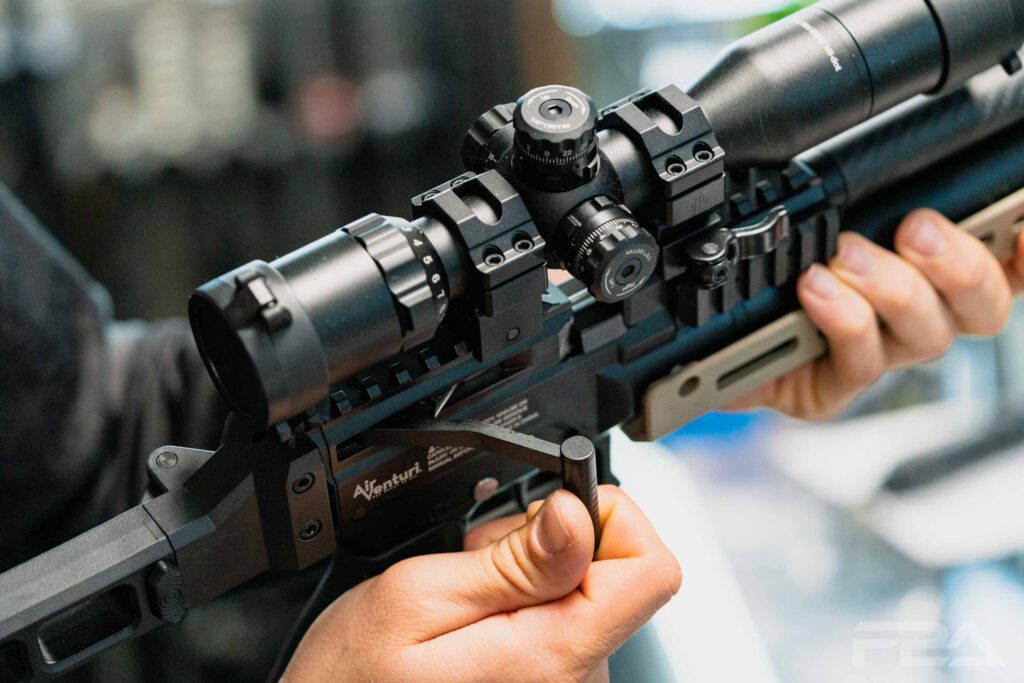
If you’re new to pre-charged pneumatic airguns, learning how to fill a PCP air rifle is one of the most important parts of ownership.
Also, if you’re still learning the basics of PCP systems, our PCP Air Rifle Guide explains reservoirs, pressure, calibers, regulators, and other key buying considerations.
Unlike a spring-powered rifle, a PCP stores compressed air inside an onboard reservoir. That air has to be replaced once pressure drops below the rifle’s useful operating range.
The good news is that there are several ways to do it.
You can fill a PCP air rifle with a high-pressure hand pump, an external HPA tank, or a dedicated PCP compressor. Each method has advantages depending on how often you shoot, the size of your rifle’s reservoir, and how much convenience you want.
This guide explains how to fill a PCP air rifle, what equipment you need, and how the three most common filling methods compare.
Before You Fill a PCP Air Rifle
Before connecting any air source, check the rifle’s manufacturer specifications.
You need to know:
- Maximum fill pressure
- Recommended operating pressure
- Fill fitting type
- Reservoir capacity
- Whether the rifle uses a probe or Foster-style connector
This matters because different rifles use different fill systems.
Never assume that two PCP rifles should be filled to the same pressure.
Some rifles operate around 3,000 PSI, while others are designed for higher pressures.
The safest way to learn how to fill a PCP air rifle is to follow the pressure range listed by the manufacturer.
What Equipment Can You Use?
There are three common ways to fill a PCP rifle:
- High-pressure hand pump
- HPA tank
- PCP air compressor
All three can work well.
The right choice depends on your shooting habits.
To understand why PCP rifles need stored compressed air in the first place, read How Does a PCP Air Rifle Work?
How to Fill a PCP Air Rifle With a Hand Pump
A hand pump is usually the least expensive way to get started.
It looks somewhat like a heavy-duty bicycle pump, but it is specifically designed to generate the much higher pressures needed by PCP rifles.
A normal bicycle pump will not work.
To fill the rifle:
- Confirm the rifle’s fill pressure.
- Attach the correct hose or fill probe.
- Make sure the connection is secure.
- Begin pumping slowly.
- Watch the pressure gauge.
- Stop when the recommended fill pressure is reached.
- Bleed pressure from the hose if your setup requires it.
- Disconnect the fitting.
This method is simple, but it can require significant effort.
Advantages of a Hand Pump
A hand pump offers several benefits.
It is:
- Relatively inexpensive
- Portable
- Independent of electricity
- Easy to store
- Useful as a backup
For shooters with smaller reservoirs, a pump may be all they need.
Disadvantages of a Hand Pump
The biggest downside is physical effort.
A large reservoir can take considerable time and energy to fill.
Higher fill pressures can also make pumping more difficult.
This means a hand pump is often best for smaller PCP rifles or occasional shooters.
If you’re trying to learn how to fill a PCP air rifle on a budget, a hand pump is usually the most accessible place to start.
How to Fill a PCP Air Rifle With an HPA Tank
An HPA tank stores compressed air separately from the rifle.
The tank is filled beforehand and then used to refill the PCP reservoir.
This is a popular solution for shooters who want fast fills without bringing a compressor everywhere.
To use an HPA tank:
- Connect the fill hose to the tank.
- Connect the other end to the rifle.
- Slowly open the tank valve.
- Watch the pressure gauge carefully.
- Stop when the rifle reaches its recommended pressure.
- Close the tank valve.
- Bleed the fill line.
- Disconnect the rifle.
The process is faster than hand pumping and requires almost no physical effort.
Advantages of an HPA Tank
An HPA tank can be very convenient.
Benefits include:
- Fast filling
- No electricity needed at the range
- Multiple fills from one tank
- Easy transport
- Less physical effort
For shooters who spend a lot of time away from home, a tank can be an excellent option.
Disadvantages of an HPA Tank
The tank itself eventually needs to be refilled.
That means you need access to a shop, compressor, or other high-pressure fill source.
Large tanks can also be heavy.
So while they are convenient during shooting sessions, they still depend on another air source.
How to Fill a PCP Air Rifle With a Compressor
A dedicated high-pressure compressor is usually the most convenient long-term solution.
These compressors are designed to reach PCP-level pressures.
To use one:
- Connect the compressor hose to the rifle.
- Confirm all fittings are secure.
- Set or monitor the desired pressure.
- Start the compressor.
- Watch the pressure gauge.
- Stop at the correct fill pressure.
- Bleed the hose if required.
- Disconnect the rifle.
Some compressors have automatic shutoff features.
Others require the user to monitor pressure manually.
Why Compressors Are Popular
If you shoot regularly, a compressor can save a lot of time.
It is especially useful if you own:
- Multiple PCP rifles
- Large bottle rifles
- High-pressure systems
- Larger-caliber PCPs
Instead of manually pumping or repeatedly refilling a tank elsewhere, you can produce your own compressed air.
For many serious PCP owners, a compressor eventually becomes the most practical option.
Hand Pump vs Tank vs Compressor
When deciding how to fill a PCP air rifle, think about convenience and frequency.
If you’re still deciding whether a PCP system is right for you compared with a simpler self-contained option, read our PCP vs Spring Air Rifle comparison.
Hand Pump
Best for:
- Beginners
- Smaller reservoirs
- Lower budgets
- Occasional shooting
Main advantage:
Low cost.
Main disadvantage:
Physical effort.
HPA Tank
Best for:
- Range use
- Fast refills
- Shooters without electricity nearby
Main advantage:
Fast and portable.
Main disadvantage:
Needs an external refill source.
Compressor
Best for:
- Frequent shooters
- Multiple PCP rifles
- Large reservoirs
- High-pressure systems
Main advantage:
Maximum convenience.
Main disadvantage:
Higher initial cost.
What Fill Pressure Should You Use?
This is one of the most important parts of learning how to fill a PCP air rifle.
Always fill to the pressure specified by the manufacturer.
Do not assume that more pressure means better performance.
Overfilling can create problems and may damage seals or other components.
A rifle designed for a particular operating range should be used within that range.
If the maximum pressure is listed as 250 bar, do not exceed it simply because your compressor can produce more.
Bar vs PSI
PCP rifles may list pressure in either bar or PSI.
Both measure pressure.
A rough conversion is:
1 bar = 14.5 PSI
So:
- 200 bar is roughly 2,900 PSI
- 250 bar is roughly 3,625 PSI
- 300 bar is roughly 4,350 PSI
Many gauges show both scales.
If your rifle and fill equipment use different units, verify the conversion before filling.
What Is a Fill Probe?
Some PCP rifles use a removable fill probe.
The probe connects to the fill hose and inserts into a port on the rifle.
Different manufacturers may use different probe designs.
This means the probe from one rifle may not fit another.
Always confirm that you have the correct fitting.
Losing a fill probe can be frustrating, so many PCP owners keep a spare.
What Is a Foster Fitting?
A Foster-style quick disconnect is another common PCP connection.
These fittings allow the hose and rifle to connect quickly.
They can make filling more convenient, especially if you own multiple PCP rifles that use compatible connectors.
Adapters are also available for many systems.
Why Do You Need to Bleed the Hose?
After filling, compressed air may remain trapped inside the hose.
Trying to disconnect the hose while it is still pressurized can make the fitting difficult to remove.
Many fill systems include a bleed valve.
The bleed valve releases pressure from the hose after the rifle valve has closed.
This makes disconnection easier.
It also reduces stress on fittings and seals.
Should You Completely Empty the Rifle Before Refilling?
Usually, no.
You generally do not need to wait until the reservoir reaches zero pressure.
In fact, many shooters refill before pressure falls below the rifle’s ideal operating range.
For example, a rifle might be filled to a higher pressure and then refilled once it reaches a lower working threshold.
This keeps the rifle operating within a consistent range.
How Often Should You Fill a PCP Air Rifle?
There is no universal schedule.
It depends on:
- Reservoir size
- Caliber
- Power level
- Regulator settings
- Shot count
- Shooting frequency
Some rifles provide many shots before needing a refill.
Others, especially high-power models, consume more air.
The pressure gauge is the best indicator.
Higher-output rifles usually consume more air, so if you’re comparing larger calibers and power levels, read High Power PCP Air Rifles
How Long Does Filling Take?
Filling time varies by method.
A hand pump may take several minutes or longer.
An HPA tank can often fill a rifle very quickly.
A compressor can also be fast, although fill time depends on compressor size and reservoir capacity.
Large bottle rifles take longer than compact PCPs.
Can You Use a Shop Compressor?
A standard workshop compressor is generally not suitable.
Most normal shop compressors operate at pressures far below what a PCP rifle needs.
PCP systems require equipment specifically designed for high-pressure air.
This distinction is important.
A compressor designed for inflating tires is not the same as a compressor designed for PCP rifles.
Can You Use a Scuba Tank?
In some setups, yes.
Scuba and SCBA tanks have historically been used by PCP shooters.
However, the tank pressure must be high enough to fill the rifle effectively.
You also need the correct regulator, hose, and fittings.
Modern portable PCP compressors have made direct filling much more convenient for many users.
Is Moisture a Problem?
Compressed air can contain moisture.
Over time, excessive moisture inside a PCP system can contribute to corrosion.
Quality compressors may include moisture filters or separators.
Hand pumps may also use moisture-filtering systems.
This is especially important in humid environments.
Should You Fill Slowly?
Yes.
Controlled filling is a good practice.
Opening a tank valve too quickly can generate heat and make pressure harder to control.
Slow filling also makes it easier to stop at the correct pressure.
This is especially important when using large external tanks.
What If the Rifle Will Not Accept Air?
If the pressure does not increase, check:
- Hose connection
- Fill probe position
- O-rings
- Bleed valve
- Tank valve
- Compressor output
Sometimes a completely empty reservoir may require slightly different filling procedures depending on the rifle.
Consult the manufacturer’s instructions if the reservoir will not begin filling normally.
What If Air Leaks During Filling?
A small leak often indicates a problem with the fitting or seal.
Check:
- Probe O-rings
- Quick disconnect
- Fill port
- Hose fittings
Do not continue filling if there is a significant leak.
Fix the connection first.
How to Make PCP Filling Easier
A few simple habits can improve the process.
Keep the fill probe clean.
Store fittings where dirt cannot enter them.
Inspect O-rings regularly.
Know your maximum fill pressure.
Use a clear pressure gauge.
And avoid rushing the fill.
Learning how to fill a PCP air rifle properly only takes a few sessions.
After that, it becomes a normal part of PCP ownership.
Which Filling Method Is Best for Beginners?
For beginners, the right choice depends on budget and shooting frequency.
A hand pump works well if you want to spend as little as possible.
An HPA tank is convenient if you have access to a local filling station.
A compressor is often the best long-term option if you plan to shoot frequently.
The key is matching the filling method to your rifle.
A compact PCP with a small reservoir is much easier to hand pump than a large bottle rifle.
Build the Right PCP Setup
The filling system is just as important as the rifle itself.
A good PCP setup includes a reliable air source, correct fittings, and a clear understanding of the rifle’s pressure limits.
If you’re still choosing your first rifle, our Best PCP Air Rifle for Beginners guide explains which features make ownership easier.
For a broader overview, see our complete PCP Air Rifle Guide.
You can also browse Palm Beach Airguns’ air rifles and PCP accessories to compare rifles, compressors, tanks, and filling equipment.
What Makes a PCP Air Rifle for Beginners Easy to Live With?
A good PCP air rifle for beginners should not only be easy to shoot, it should also be easy to own.
That means the rifle should have straightforward controls, a manageable fill pressure, easy-to-find magazines, and a filling system that does not make every shooting session feel like a project.
For many first-time buyers, the best PCP air rifle for beginners is one that works well right out of the box. New shooters usually benefit more from reliability and consistency than from advanced tuning features they may not use immediately.
Another important factor is how often the rifle needs to be filled. A PCP air rifle for beginners with a practical shot count can make the ownership experience much more enjoyable. If the rifle needs constant refilling, a new shooter may quickly become frustrated, especially when using a hand pump.
Weight also matters. A lightweight PCP air rifle for beginners is easier to carry, easier to shoulder, and usually more comfortable during longer shooting sessions. This can be especially important for younger adults, smaller-framed shooters, or anyone who does not want a heavy bottle-style rifle.
A beginner-friendly rifle should also use common ammunition. Choosing a PCP air rifle for beginners in .177, .22, or .25 makes it easier to find pellets, compare different brands, and experiment with projectile weights without spending a lot of money.
The best PCP air rifle for beginners should also have clear manufacturer documentation. Good manuals, easy access to replacement parts, and available fill fittings can make a major difference when someone is still learning how PCP systems work.
It is also worth thinking about maintenance. A quality PCP air rifle for beginners should not require constant adjustment or repair. Basic care, clean fill fittings, correct pressure, and proper storage should be enough for normal use.
For buyers who are still deciding between several models, it helps to compare each PCP air rifle for beginners by the same criteria:
- Ease of filling
- Shot count
- Rifle weight
- Caliber
- Magazine capacity
- Fill pressure
- Regulator
- Replacement parts
- Manufacturer support
These factors usually matter more than chasing maximum velocity.
A reliable PCP air rifle for beginners should make it easy to learn the platform without creating unnecessary complexity. Once the shooter becomes more experienced, they can always move into a more adjustable or higher-powered rifle.
That is why the right PCP air rifle for beginners should focus first on simplicity, comfort, consistency, and practical ownership.