If you are shopping for a pistol that does not use traditional firearm ammunition, two terms can appear almost interchangeable: airsoft pistol and air pistol. They may look similar, and some models are designed around the same real-world handgun shapes, but they are built for very different purposes. Understanding the airsoft pistol vs air pistol distinction matters before you buy because the ammunition, power systems, performance, intended use, safety considerations, and accessories can all be different.
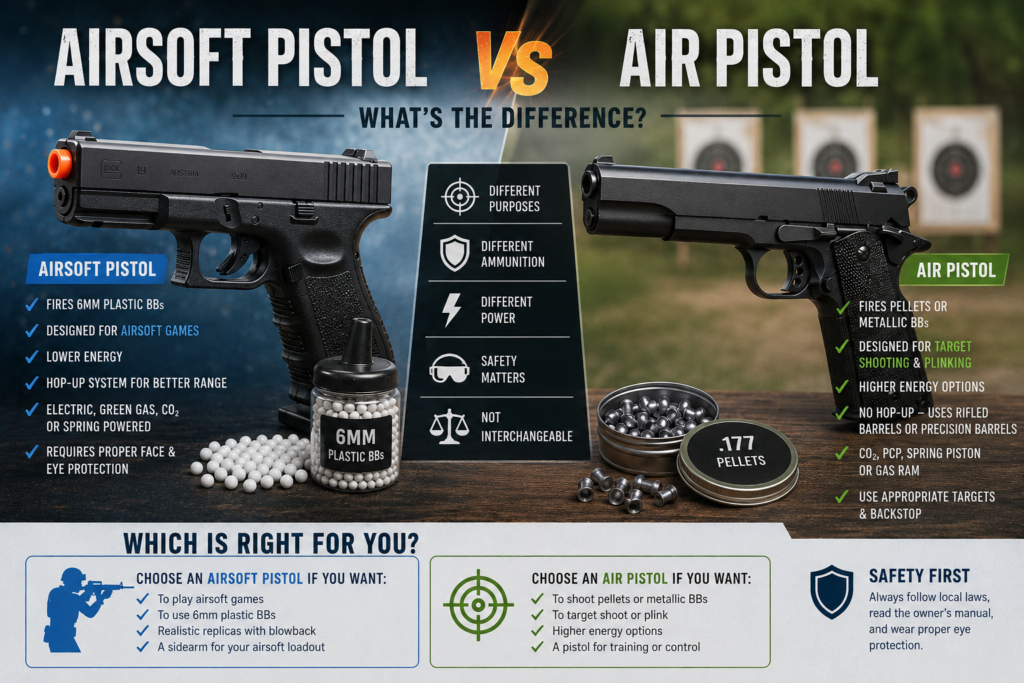
For most buyers, the simplest distinction is this: airsoft pistols are generally designed around 6 mm plastic BBs and recreational airsoft play, while air pistols typically fire metal pellets or BBs and are used for activities such as target shooting, plinking, training, and—in appropriate models and where lawful—pest control or small-game applications.
That basic definition is useful, but there is much more to consider. This guide breaks down the airsoft pistol vs air pistol comparison so you can identify the category that better matches your intended use.
What Is an Airsoft Pistol?
An airsoft pistol is a low-energy replica-style gun designed to fire lightweight plastic BBs, most commonly 6 mm in diameter. Depending on the model, it may be powered by electricity, green gas, CO2, or a spring.
If you are especially interested in rechargeable airsoft platforms, our guide to choosing the best battery powered airsoft gun explains batteries, voltage, FPS, reliability, and other factors that matter when comparing electric models.
Airsoft pistols are especially popular because they can combine recreational performance with realistic dimensions and controls. Many are modeled after familiar handgun platforms, and licensed replicas may reproduce features such as slide profiles, grip shapes, safeties, magazine releases, accessory rails, and manufacturer markings.
Gas blowback models can cycle the slide when fired, adding movement and feedback. Electric pistols prioritize easy operation and consistency, while non-blowback CO2 or gas pistols may emphasize efficiency.
Palm Beach Airguns carries a dedicated selection of airsoft pistols, including gas, CO2, and other configurations. If you are specifically interested in rechargeable systems, the guide to choosing the best battery powered airsoft gun explains electric platforms, batteries, FPS, and related considerations.
What Is an Air Pistol?
An air pistol is a handgun-style airgun that uses compressed air or another pressurized gas to launch a projectile. Depending on the platform, that power may come from a pre-charged pneumatic system, CO2 cartridge, spring piston, gas ram, or another airgun mechanism.
Unlike most airsoft pistols, air pistols generally fire metallic ammunition. Common examples include diabolo-shaped pellets and steel BBs, although the exact projectile depends on the model. Calibers and power levels also vary considerably.
The airsoft pistol vs air pistol difference becomes especially important here because an air pistol should not be treated as simply a more powerful airsoft gun. The ammunition, energy, intended target, backstop requirements, and safe shooting environment may be fundamentally different.
Palm Beach Airguns has a separate air pistols category for shooters looking for pellet, BB, CO2, PCP, and other air-powered pistol platforms.
Airsoft Pistol vs Air Pistol: Quick Comparison
The easiest way to compare the two categories is to look at their core characteristics.
| Feature | Airsoft Pistol | Air Pistol |
|---|---|---|
| Typical projectile | 6 mm plastic BB | Pellet or metallic BB |
| Common purpose | Airsoft play, recreation, training | Target shooting, plinking, training |
| Typical power systems | Electric, green gas, CO2, spring | PCP, CO2, spring piston, gas ram |
| Projectile energy | Generally lower | Often higher |
| Blowback | Common on gas models | Available on some replica models |
| Hop-up | Common | Generally not used in the same way |
| Field play | Designed for airsoft games | Not for shooting at other players |
| Targets/backstop | Airsoft-rated environment | Appropriate airgun-rated target and backstop |
| Protective gear | Required for play | Eye protection and controlled range practices |
| Ammunition interchangeability | No | No |
The central lesson in any airsoft pistol vs air pistol comparison is that visual similarity does not make the two categories interchangeable.
The Biggest Difference: Ammunition
Ammunition is one of the clearest ways to understand the airsoft pistol vs air pistol distinction. Although the two types of pistols can look remarkably similar from the outside, the projectiles they are designed to fire are fundamentally different. For anyone comparing airsoft pistol vs air pistol options, checking the ammunition specification is one of the fastest ways to determine which category a product belongs to.
Airsoft guns most commonly use lightweight, spherical 6 mm plastic BBs. BB weight varies, and choosing an appropriate weight can affect trajectory, hop-up performance, consistency, and how the pistol performs at different distances. Because these projectiles are designed specifically for airsoft equipment, they should only be used in compatible airsoft guns.
Air pistols, by comparison, commonly use metal pellets or BBs. Pellets are available in different calibers, weights, and shapes depending on the platform and intended shooting purpose. Some pistols are designed specifically for pellets, some for steel BBs, and some models can use more than one projectile type when the manufacturer specifically states that capability.
This difference in ammunition is central to any airsoft pistol vs air pistol comparison. A lightweight plastic airsoft BB behaves very differently from a metal pellet or steel BB, even when the two products firing them may share similar styling or dimensions.
Never assume ammunition can be substituted simply because it appears to fit into part of the loading system. Always follow the manufacturer’s caliber and ammunition instructions. The safest approach when considering airsoft pistol vs air pistol products is to treat their ammunition systems as completely separate unless the manufacturer explicitly states otherwise.
When evaluating airsoft pistol vs air pistol options, the projectile alone tells you a great deal about how the product is intended to be used. Ammunition affects not only performance but also the appropriate targets, backstops, shooting environment, and safety precautions.
Power Sources: Electric, Gas, CO2 and PCP
Power systems are another important part of the airsoft pistol vs air pistol comparison because both categories can use several different methods to propel a projectile.
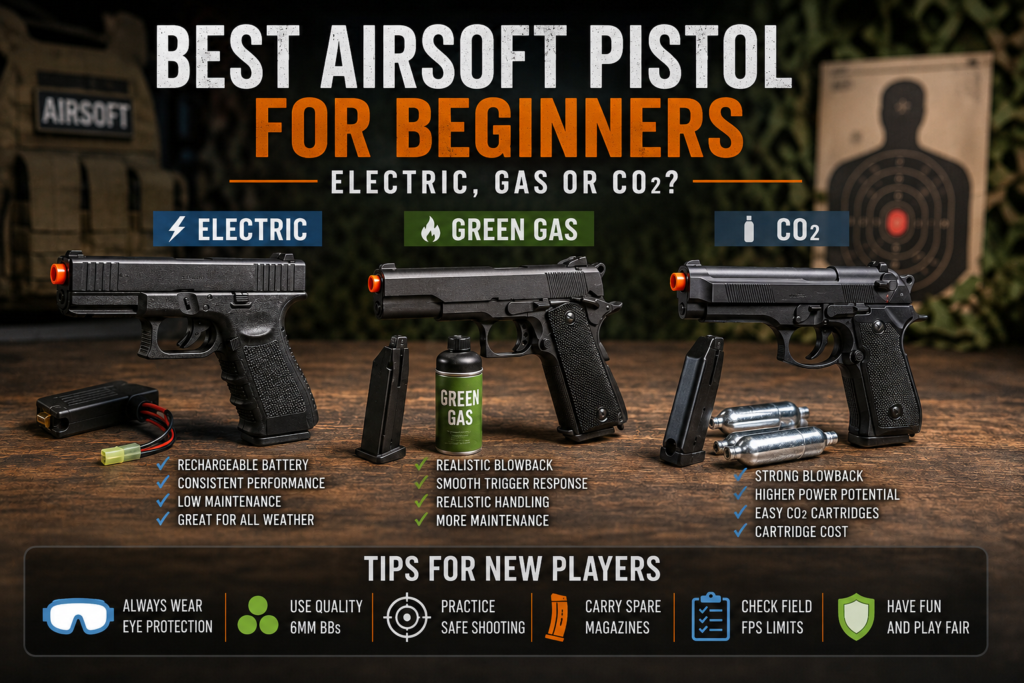
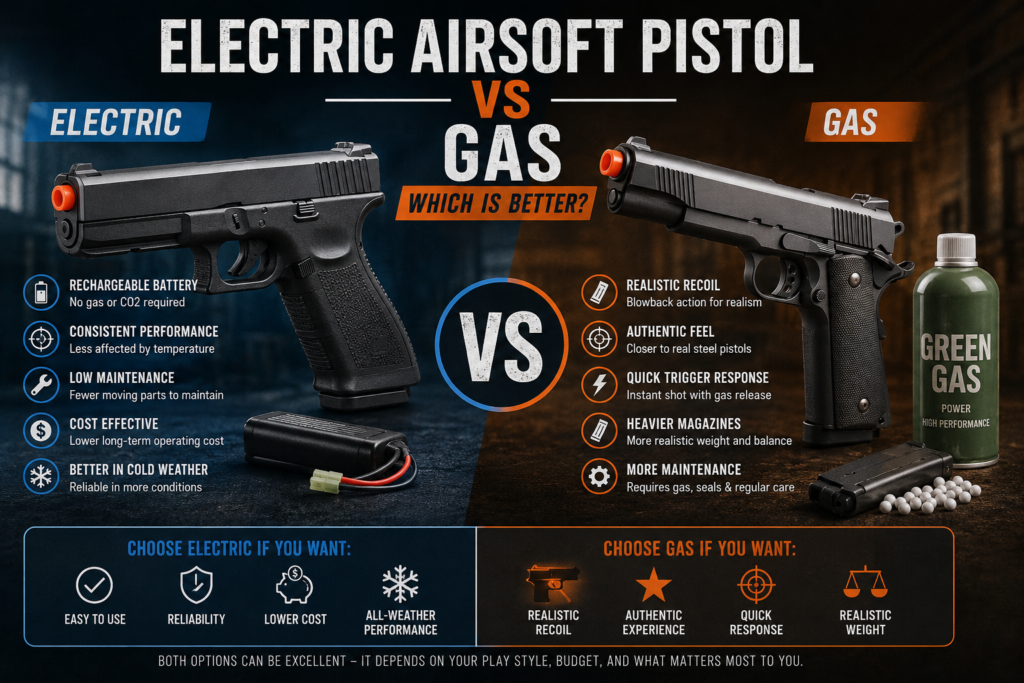
Airsoft pistols have several common power systems. Electric pistols use rechargeable batteries and compact gearboxes to cycle the firing mechanism. Gas blowback pistols typically use green gas or CO2 and may cycle the slide to produce more realistic movement. Spring pistols are manually cocked between shots and generally offer a simpler mechanical design.
For buyers researching airsoft pistol vs air pistol, it is important to understand that seeing “CO2 powered” in a product description does not automatically tell you which type of pistol you are looking at. CO2 can be found in both airsoft and traditional airgun products.
Air pistols also vary widely. CO2 is particularly common in recreational replica pistols. Spring-piston designs store mechanical energy before the shot, while PCP, or pre-charged pneumatic, pistols use a high-pressure air reservoir filled with appropriate charging equipment.
This makes the airsoft pistol vs air pistol question more complicated than simply comparing electric power with compressed air. Both categories may use compressed gas, and both can include CO2 models. The real distinction comes from considering the complete system: projectile, energy, design, caliber, intended purpose, and operating specifications.
If you are deciding specifically between electric and gas operation, our electric airsoft pistol vs gas comparison looks at maintenance, weather performance, realism, operating costs, and which system may be better for different types of players.
When comparing airsoft pistol vs air pistol models that both use CO2, always check the ammunition specification before assuming they belong to the same category.
Power and Velocity Are Not the Same Thing
FPS is frequently used when discussing both airsoft guns and airguns, but velocity by itself does not tell the full story. This is particularly important when researching airsoft pistol vs air pistol performance because two projectiles traveling at similar speeds can carry very different amounts of energy.
A lightweight airsoft BB traveling at a particular velocity does not carry the same energy as a substantially heavier metal pellet traveling at that same speed. Projectile mass matters, and that difference affects how each product should be evaluated and used.
That is why buyers should avoid comparing two products based only on the FPS number printed in a specification table. In an airsoft pistol vs air pistol comparison, ammunition type, projectile weight, and energy are just as important as velocity.
For airsoft, field limits are often based on velocity and/or joules measured with a specified BB weight. Airgun users, meanwhile, should pay close attention to the manufacturer’s stated ammunition recommendations, intended use, and appropriate target and backstop requirements.
Looking only at FPS can therefore make an airsoft pistol vs air pistol comparison misleading. A more useful approach is to consider the complete performance specification rather than treating velocity as the only measurement that matters.
Accuracy and Effective Range
Both categories can be accurate when used within their intended roles, but they achieve that performance differently. Understanding those differences helps make the airsoft pistol vs air pistol accuracy question much easier to evaluate.
Airsoft pistols often use an adjustable hop-up system that applies controlled backspin to the plastic BB. That backspin helps extend the BB’s useful trajectory. BB quality, weight, hop-up adjustment, barrel condition, and shot-to-shot consistency can all influence accuracy.
Air pistols firing pellets may use rifled barrels and projectile shapes designed for stable flight. Precision-oriented air pistols can be capable of excellent target accuracy, while recreational BB pistols may prioritize simplicity, quick handling, or replica-style operation.
Because the systems are built for different purposes, an airsoft pistol vs air pistol accuracy comparison should always consider the type of shooting involved. Hitting an airsoft-sized target during recreational play is very different from trying to produce tight groups on a paper target.
The winner of an airsoft pistol vs air pistol accuracy comparison therefore depends largely on what “accuracy” means in context. Neither category should automatically be considered more accurate simply because one produces a higher velocity or uses a heavier projectile.
Intended Use: Where the Categories Separate
Intended use is arguably the most important consideration in the entire airsoft pistol vs air pistol discussion.
Airsoft pistols are built around airsoft. They may be used as sidearms during games, for recreational target use, or in certain controlled training environments. Airsoft fields establish their own safety rules, velocity limits, equipment requirements, engagement rules, protective-equipment standards, and approved firing modes.
Air pistols are not airsoft substitutes. They are designed for controlled shooting at appropriate targets rather than for use in player-versus-player airsoft games.
That intended-use difference is why an airsoft pistol vs air pistol decision should begin with the activity you plan to participate in rather than with appearance, price, or advertised FPS.
This distinction should remain clear even when an air pistol visually resembles an airsoft replica. A realistic-looking CO2 air pistol firing metal BBs and a gas blowback airsoft pistol firing 6 mm plastic BBs may look very similar at a glance, yet their projectiles and safe-use requirements are not the same.
For someone completely new to both categories, the simplest airsoft pistol vs air pistol rule is to determine what you want to do first. If the goal is participating in airsoft games, choose equipment specifically intended and approved for airsoft. If the goal is pellet or metallic-BB target shooting, look at air pistols designed for that purpose.
Realism and Replica Design
One reason buyers sometimes struggle with the airsoft pistol vs air pistol distinction is that manufacturers produce highly realistic examples in both categories.
An airsoft pistol may closely reproduce the dimensions, controls, markings, grip profile, and magazine shape of a familiar handgun platform. Gas blowback can add slide movement and mechanical feedback, making the experience feel even more realistic.
Some CO2 air pistols are also designed as detailed replicas. They can have realistic weight, familiar controls, metal slides, drop-free magazines, accessory rails, and recognizable grip geometry.
As a result, appearance is one of the least reliable ways to settle an airsoft pistol vs air pistol comparison. Two products may look nearly identical while firing completely different projectiles and serving different purposes.
So realism alone cannot settle the airsoft pistol vs air pistol question. The correct way to identify the product is to check its caliber, projectile type, power source, manufacturer specifications, and intended use. Once those factors are clear, the difference between the two categories becomes much easier to understand.
Which Is Better for Recreational Airsoft Games?
For an actual airsoft game, the answer is straightforward: use an airsoft gun that meets the field’s rules.
Airsoft pistols are designed around plastic airsoft ammunition and the safety structure of the sport. Even then, players need approved eye protection, appropriate protective equipment, and compliance with field velocity and engagement rules.
An air pistol firing pellets or metallic BBs should never be substituted for an airsoft pistol in player-versus-player games.
If your goal is to participate in airsoft, browsing a dedicated airsoft selection is a better starting point than shopping the broader airgun category.
Which Is Better for Target Shooting?
This depends on the kind of target shooting you want to do.
An airsoft pistol can be enjoyable for short-range recreational targets, practicing presentation and manipulation with an appropriate replica, or casual accuracy challenges. Consumable ammunition is relatively lightweight and the platform can be convenient.
An air pistol may be more appropriate when your priority is traditional pellet or BB target shooting. There are air pistols specifically designed for precision, plinking, and other target-oriented uses.
For a buyer deciding between airsoft pistol vs air pistol, the key question is not simply “Which is more accurate?” Ask what type of target you will shoot, at what distance, in what environment, and what level of precision you expect.
Which Is Better for Beginners?
Either can be suitable for a beginner when the buyer understands the intended use and safe handling requirements.
A beginner interested in the sport of airsoft should start with an airsoft platform and learn the rules of the field where they intend to play. For someone focused on backyard or range-style target shooting where legal and safe, an appropriate air pistol may make more sense.
Electric airsoft pistols can be particularly approachable because they use rechargeable power and eliminate much of the gas-magazine maintenance associated with gas blowback systems. You can read more about those tradeoffs in Palm Beach Airguns’ Best Airsoft Pistol guide.
New players may also want to compare the most common airsoft power systems before choosing a first sidearm. Our guide to the best airsoft pistol for beginners compares electric, green gas, and CO2 options and explains the tradeoffs in maintenance, realism, cost, and ease of use.
When making an airsoft pistol vs air pistol decision for a first purchase, choose based on the activity first and the specific model second.
Cost of Ownership
Purchase price is only part of the budget.
For airsoft pistols, recurring costs may include plastic BBs, green gas, CO2 cartridges, batteries, chargers, spare magazines, and protective equipment. The exact list depends on the power system.
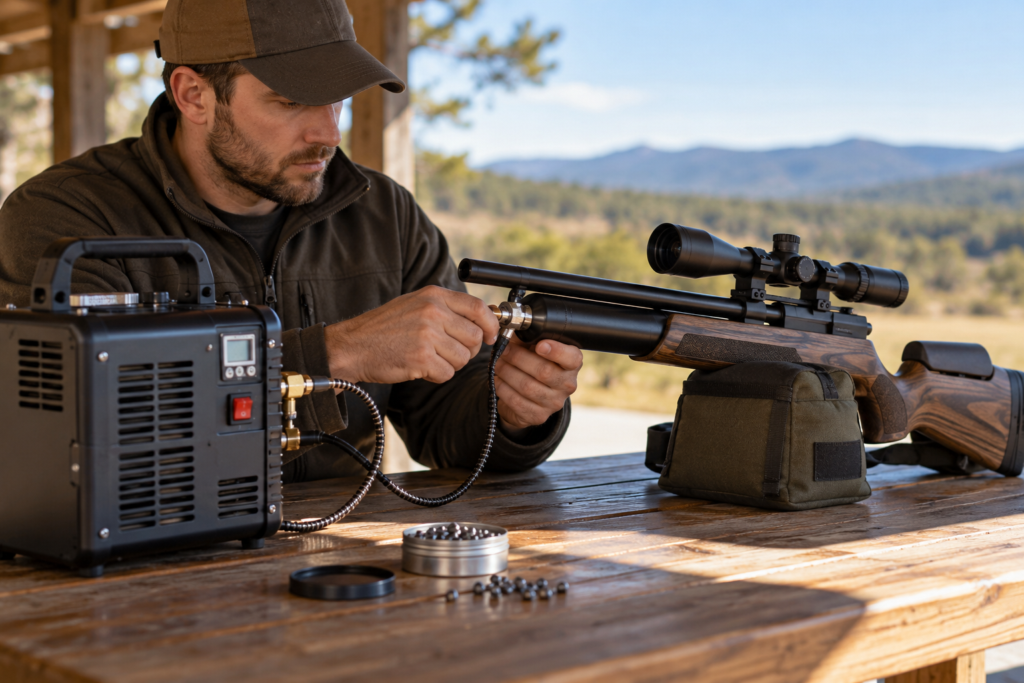
For air pistols, owners may need pellets or BBs, CO2 cartridges, or PCP charging equipment. A PCP pistol can involve a larger initial investment because a suitable pump, compressor, or tank may be necessary depending on the model.
Maintenance supplies and replacement seals can also matter for gas-powered equipment.
The cheapest product on the shelf is not always the least expensive to own over several years.
Maintenance Differences
Electric airsoft pistols generally require attention to battery care, barrel cleanliness, connectors, and the health of the internal gearbox. Gas airsoft pistols add valves, seals, and gas magazines to the maintenance routine.
Air pistols vary even more. A CO2 replica pistol may require relatively simple seal and barrel care, while a PCP platform includes a high-pressure air system that must be operated according to manufacturer instructions.
The airsoft pistol vs air pistol maintenance comparison is therefore highly model-dependent. Rather than assuming one entire category is easier, review the manual and understand the consumables, seals, batteries, charging equipment, and replacement parts associated with the specific product.
Safety: Treat the Difference Seriously
Neither category should be treated as harmless simply because it does not use firearm ammunition.
Airsoft projectiles can injure eyes and teeth, which is why proper protective equipment is essential during airsoft play. Air pistols firing metallic projectiles require a controlled shooting environment, a suitable target, and a backstop appropriate for the specific airgun and ammunition.
ASTM International maintains dedicated standards covering airsoft equipment and field practices through its Subcommittee F08.27 on Airsoft. Its active standards include specifications for airsoft guns and projectiles as well as practices addressing field operation and player safety briefings.
Always follow the manufacturer’s instructions, applicable local laws, and the rules of the range, field, or property where the product will be used.
Can Airsoft BBs Be Used in an Air Pistol?
Only use the projectile type and caliber specifically approved by the manufacturer.
A 6 mm plastic airsoft BB is not a substitute for an airgun pellet or steel BB, and metallic airgun ammunition should never be loaded into an airsoft gun unless a product’s manufacturer explicitly designed and specified it—which standard airsoft guns are not.
The safest rule in the airsoft pistol vs air pistol debate is simple: treat the ammunition systems as separate and follow the owner’s manual.
Can an Air Pistol Be Used for Airsoft?
No. A pellet or metallic-BB air pistol is not appropriate for player-versus-player airsoft use.
Airsoft is organized around equipment and projectiles intended for that activity, along with field-specific energy limits and protective-equipment rules. The fact that two products look similar or both use CO2 does not make them interchangeable.
This is one of the most important points for a new buyer to understand.
How to Tell Which Type You Are Looking At
When product names are confusing, check these five details:
- Caliber: A 6 mm designation is common for airsoft. Air pistols may be listed in .177, .22, or other airgun calibers depending on the model.
- Ammunition: Look specifically for plastic airsoft BBs, steel BBs, or pellets.
- Category: Reputable retailers normally separate airsoft from airgun products.
- Power system: Useful, but not decisive by itself because both categories can include CO2.
- Manufacturer description: Confirm the model’s intended use and compatible ammunition.
These checks are much more reliable than judging by appearance.
Which Should You Buy?
Choose an airsoft pistol if your primary goal is:
- Participating in airsoft games
- Using a replica-style sidearm
- Shooting lightweight 6 mm plastic BBs
- Building an airsoft loadout
- Practicing recreationally with equipment designed for airsoft
Choose an air pistol if your primary goal is:
- Pellet or metallic-BB target shooting
- Plinking in an appropriate controlled environment
- Using an airgun specifically designed for precision or recreational shooting
- Exploring CO2, spring, or PCP pistol platforms
- Shooting appropriate non-player targets with a suitable backstop
That activity-based approach is far more useful than asking which category is “better.”
Airsoft Pistol vs Air Pistol: Final Verdict
The airsoft pistol vs air pistol choice becomes simple once you stop comparing appearance and start comparing purpose.
Airsoft pistols are built around lightweight plastic BBs and the recreational sport of airsoft. They are available in electric, gas, CO2, and spring-powered designs, with many models emphasizing replica styling and field-friendly performance.
Air pistols belong to the broader airgun category. They commonly fire pellets or metallic BBs and can range from inexpensive recreational CO2 pistols to sophisticated PCP platforms built around precision and power.
Neither category is universally better. They solve different problems.
If you want to play airsoft, choose an airsoft pistol that complies with your field’s rules. If you want to shoot pellets or BBs at appropriate targets, explore air pistols designed for that purpose. And if you are unsure what a particular product is, verify its caliber and ammunition before buying or loading it.
Understanding that distinction helps you choose the right equipment, the right accessories, and the right safety setup from the beginning.
Frequently Asked Questions
1. What is the main difference between an airsoft pistol and an air pistol?
The main difference is the projectile and intended use. Airsoft pistols typically shoot lightweight 6 mm plastic BBs and are designed for airsoft games and recreation. Air pistols generally shoot pellets or metallic BBs and are intended for target shooting, plinking, training, or other airgun applications appropriate to the model.
2. Is an air pistol more powerful than an airsoft pistol?
Air pistols often operate at higher projectile energies, but specifications vary widely by model. FPS alone is not enough to make a meaningful comparison because projectile weight strongly affects energy. Always compare products using their actual ammunition and manufacturer specifications.
3. Can I use an air pistol in an airsoft game?
No. A pellet or metallic-BB air pistol should not be used in player-versus-player airsoft. Airsoft fields are designed around approved airsoft equipment, lightweight plastic projectiles, protective gear, and field-specific energy limits.
4. Is an airsoft pistol good for target practice?
Yes, an airsoft pistol can be useful for recreational short-range target shooting and replica handling practice in an appropriate setting. If precision pellet shooting is your main objective, however, an air pistol designed for target shooting may be the better choice.
5. Which is better for a beginner: airsoft pistol vs air pistol?
The answer depends on the activity. A beginner who wants to play airsoft should choose an airsoft pistol or another suitable airsoft platform. A beginner primarily interested in shooting pellets or metallic BBs at appropriate targets should consider an air pistol. Start with the intended use, then compare models within the correct category.